
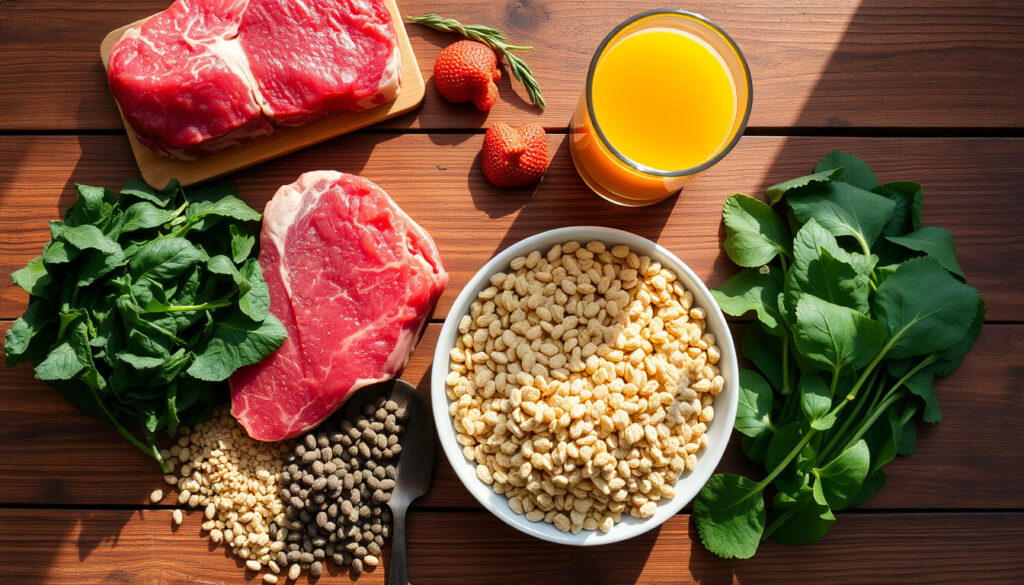
Few things affect your day-to-day energy quite like iron levels. That sluggish feeling, the difficulty concentrating, the cold hands — they all trace back to how much iron you’re getting from your plate. This guide cuts through the noise to show you exactly which foods deliver the most iron, how to pair them for maximum absorption, and what to skip if you want your levels to rise.
Global iron deficiency prevalence: Affects 2 billion people (WHO) ·
Daily iron need (adult women): 18 mg ·
Daily iron need (adult men): 8 mg ·
Iron in 3 oz beef liver: 5 mg
Quick snapshot
- Heme iron from red meat, liver, and clams absorbs at 15-35% (HealthLink BC)
- Non-heme iron in spinach, lentils, and tofu absorbs at 2-20% (HealthLink BC)
- Pairing vitamin C with non-heme iron can double absorption (UBC Food)
- In Canada, white flour and meat substitutes must be fortified with iron (HealthLink BC)
- Exact bioavailability of iron from different cooking methods
- Optimal daily egg intake to meaningfully raise iron levels
- How much absorbed iron varies by individual gut microbiome
- Iron levels can improve within days of eating iron-rich meals with vitamin C (UnlockFood.ca)
- Full iron stores (ferritin) take weeks to months to replenish through diet alone (Alberta Health Services)
- Symptoms like fatigue may lift within 1-2 weeks of consistent intake (The Ottawa Hospital)
- Add a serving of liver or clams once a week for heme iron (HealthLink BC)
- Combine lentils with bell peppers or citrus for non-heme iron (UnlockFood.ca)
- Avoid tea and coffee within 1 hour of meals to prevent blocking absorption (UBC Food)
Here is how common foods stack up by iron content per serving.
| Food | Serving size | Iron content (mg) |
|---|---|---|
| Clams | 100 g | 28 |
| Beef liver | 3 oz (85 g) | 5 |
| Pumpkin seeds, roasted | ¼ cup (60 mL) | 4.7 |
| Cold cereal with added iron | 30 g | 4.5 |
| Lentils (cooked) | ¾ cup (175 mL) | 3.3-4.9 |
| Tofu, extra firm | 75 g | 4 |
| Cashews, almonds, pine nuts | ¼ cup | 2-4 |
| Spinach (cooked) | ½ cup | 3.2 |
| Prune juice | 1 cup | 3 |
| Raisins | ½ cup | 1.4-2.7 |
| Dried apricots | ½ cup | 1.4 |
| Large egg | 1 egg | 0.9 |
What food is highest in iron?
Top heme iron sources
- Beef liver provides about 5 mg per 3 oz serving (HealthLink BC)
- Clams top the list with 28 mg per 100 g (HealthLink BC)
- Red meat (beef, lamb) offers 2-3 mg per 3 oz (Alberta Health Services)
- Poultry like chicken and turkey provides about 1-1.5 mg per serving (HealthLink BC)
Top non-heme iron sources
- Lentils (¾ cup) deliver 3.3 to 4.9 mg iron (HealthLink BC)
- Pumpkin seeds (¼ cup) provide 4.7 mg (HealthLink BC)
- Fortified cereals (30 g) contain 4.5 mg added iron (HealthLink BC)
- Tofu, extra firm (75 g) offers 4 mg (The Ottawa Hospital)
The catch: the body absorbs heme iron 2-7 times more efficiently than non-heme, meaning a smaller serving of liver can deliver more usable iron than a large bowl of spinach.
For someone with low iron levels, a single 100 g serving of clams provides more absorbed iron than a entire day of plant-based eating — unless those plants are paired with vitamin C.
How can I raise my iron fast?
Iron supplements
- Oral iron supplements (ferrous sulfate) can raise levels quickly but often cause constipation and nausea (Alberta Health Services)
- Supplements should be taken with vitamin C and on an empty stomach for best absorption (UnlockFood.ca)
Iron-rich foods to eat immediately
- Beef liver or clams deliver the highest density per bite (HealthLink BC)
- Add a handful of pumpkin seeds to oatmeal or yogurt for 4.7 mg (HealthLink BC)
- Fortified cereal with strawberries is a quick, high-iron breakfast (HealthLink BC)
Vitamin C for absorption
- Pair non-heme iron foods with citrus, bell peppers, or broccoli to increase absorption up to 6 times (UBC Food)
- Example: hummus with red bell pepper slices or lentil soup with lemon juice (UnlockFood.ca)
What to avoid
- Avoid tea and coffee within 1 hour of meals — tannins block non-heme iron absorption (UBC Food)
- Calcium from dairy also interferes; separate iron-rich meals from milk or cheese by at least 2 hours (Alberta Health Services)
The trade-off: you can raise iron fast with supplements, but food-based approaches offer better tolerability and additional nutrients — just watch the timing around tea and coffee.
Which drink is high in iron?
Prune juice
- Prune juice contains about 3 mg per cup (HealthLink BC)
- Also provides fiber and vitamin C, which aids absorption (UnlockFood.ca)
Beetroot juice
- Beetroot juice provides iron and folate, both important for red blood cell production (Canada Cloud Pharmacy)
- Contains vitamin C to support non-heme iron absorption (Alberta Health Services)
Green smoothies with spinach
- A smoothie with spinach, berries, and orange juice delivers iron plus vitamin C (UnlockFood.ca)
- Avoid adding milk or yogurt to the smoothie — calcium can reduce iron absorption (UBC Food)
Drinks are a secondary iron source — prune juice at 3 mg per cup barely touches a woman’s 18 mg daily need. They work best as an extra boost, not the main event.
What fruit is high in iron?
Dried fruits
- Dried apricots provide 1.4 mg per ½ cup (HealthLink BC)
- Raisins contribute 1.4-2.7 mg per ½ cup (HealthLink BC)
- Prunes also offer iron and are easy to add to cereal or trail mix (UnlockFood.ca)
Berries
- Mulberries are notably rich in iron — 2.6 mg per ¼ cup (HealthLink BC)
- Strawberries provide vitamin C, which helps absorb iron from other foods (Alberta Health Services)
Pomegranate
- Pomegranate seeds and juice contain small amounts of iron plus vitamin C (Canada Cloud Pharmacy)
- Not a primary source but useful as part of a varied diet (UBC Food)
The pattern: fruits alone won’t meet daily iron needs — a woman would need 13 cups of dried apricots to hit 18 mg — but they’re excellent for pairing with other foods for better absorption.
Can you get enough iron from eggs?
Iron content in eggs
- One large egg contains about 0.9 mg iron (HealthLink BC)
- The iron is mostly in the yolk — eating egg whites alone gives almost none (Alberta Health Services)
Heme vs non-heme in eggs
- Eggs contain heme iron, which absorbs 15-35%, better than plant sources (HealthLink BC)
- But the amount per egg is still small compared to meat or fortified foods (The Ottawa Hospital)
How many eggs to meet iron needs
- Two eggs provide about 1.8 mg — not enough for daily needs alone (HealthLink BC)
- An adult woman would need 20 eggs per day to meet her 18 mg requirement (Alberta Health Services)
- Eggs are best as a supporting player alongside liver, lentils, or fortified cereals (UnlockFood.ca)
“Beef liver provides the highest iron content among common foods, with about 5 mg per 3 oz serving.”
“Liver, red meat, beans, and dried fruit are all good sources of iron. Pairing them with vitamin C-rich foods helps the body absorb the iron.”
Frequently asked questions
Are iron supplements better than food sources?
Supplements offer a concentrated dose and are useful for diagnosed deficiency, but food sources provide additional nutrients and are better tolerated. Always consult a doctor before taking supplements, as excess iron is toxic (Alberta Health Services).
Can iron-rich foods cause constipation?
Food-based iron rarely causes constipation — that’s more common with supplements. Iron from foods like lentils, spinach, and seeds also provides fiber, which aids digestion (HealthLink BC).
Is it safe to eat liver every week?
Liver is very high in vitamin A and iron. Eating it once a week is safe for most adults, but people with hemochromatosis or pregnant women should limit intake. Check with your doctor for personal guidance (Canada Cloud Pharmacy).
What is the best time of day to take iron?
For supplements, take them on an empty stomach with vitamin C (like orange juice) and avoid tea, coffee, or dairy for 1 hour before and after. For food-based iron, absorption is best when spaced away from inhibitors (UnlockFood.ca).
Do cooking methods affect iron content in vegetables?
Boiling can leach iron into cooking water — use minimal water or steam instead. Cooking in a cast-iron pan can actually add iron to acidic foods like tomatoes or spinach (UBC Food).
How can vegetarians increase iron absorption?
Pair non-heme iron foods (lentils, spinach, tofu) with vitamin C sources like citrus, bell peppers, or broccoli. Avoid tea, coffee, and calcium-rich dairy within 1 hour of meals. Soaking beans and grains reduces phytate, which blocks absorption (UnlockFood.ca).
What are the symptoms of iron deficiency?
Common symptoms include fatigue, weakness, pale skin, shortness of breath, dizziness, cold hands and feet, and brittle nails. If you experience these, a simple blood test (hemoglobin and ferritin) can confirm your levels (The Ottawa Hospital).
For anyone dealing with low energy or diagnosed low iron, the path forward is clear: prioritize heme sources like liver or clams once a week, pair plant-based iron with vitamin C, and time your meals away from tea and coffee. The goal isn’t to overhaul your diet overnight — it’s to build small, consistent habits that keep your iron stores steady. For Canadian women especially, where 18 mg daily is the standard, a single serving of fortified cereal with berries every morning closes a meaningful gap.
Related stories





Kevin Sullivan covers culture, lifestyle and society across Canada for Canada Scope.