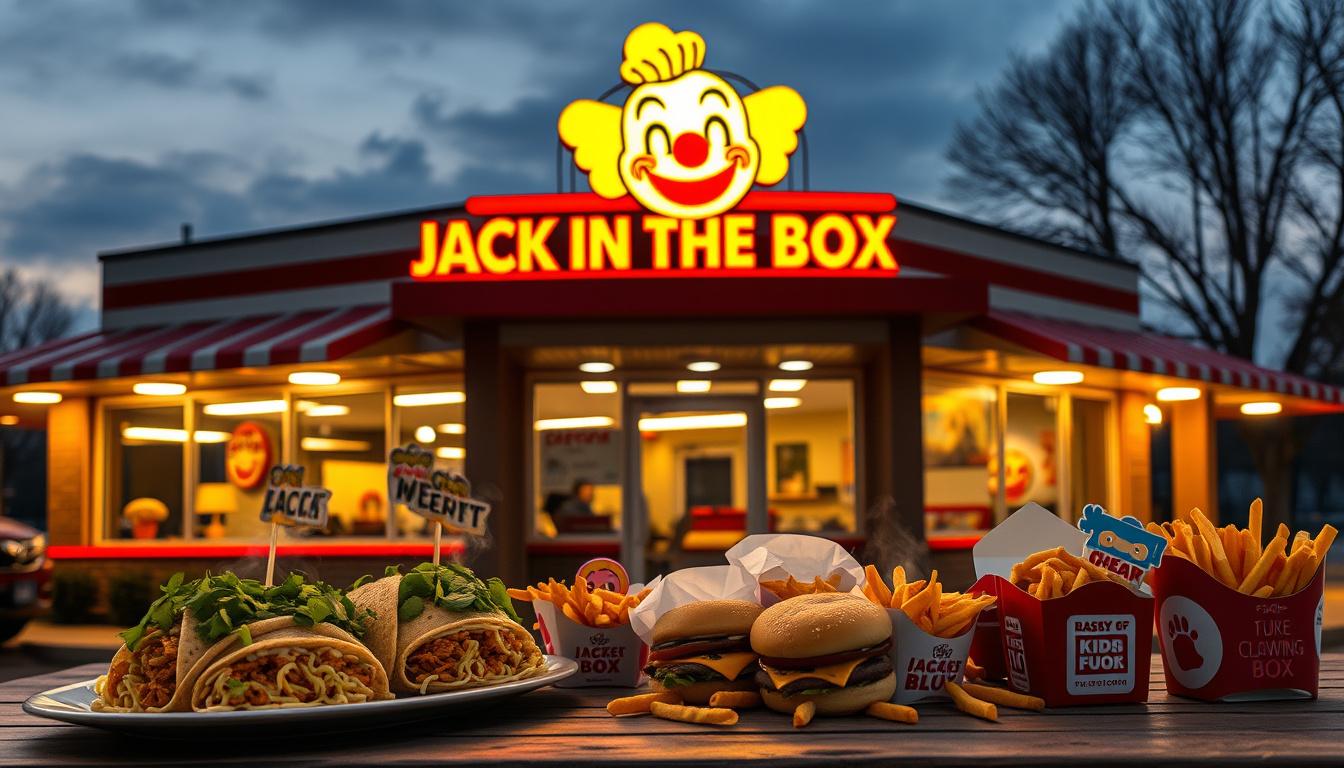
Jack in the Box built its identity on a grinning clown mascot, but in 1992–1993 that cartoon cheer curdled into a food-safety catastrophe that killed four children, hospitalized hundreds, and rewrote federal food safety law. The tension between the playful brand and this dark chapter is what makes the chain’s story worth telling.
Founded: 1951 · Headquarters: San Diego, California · Key Incident: 1992–1993 E. coli outbreak · Toy Origin: music box with crank
Quick snapshot
- 4 deaths linked to the outbreak (Wikipedia)
- 477 culture-confirmed cases in Washington state alone (Marler Clark)
- Contaminated patties traced to November 29–30, 1992 production (Marler Clark)
- Exact total case count varies across sources (503–732 reported range)
- Long-term settlement amounts for victims reportedly not fully disclosed
- Whether the clown mascot design changed post-crisis lacks clear sourcing
- First illness onset: November 18, 1992
- Washington DOH named Jack in the Box publicly: January 18, 1993
- Last case onset: February 21, 1993
- Chain remains operational with 2,200+ locations across the U.S.
- E. coli O157:H7 became federally reportable following the crisis
- Industry-wide cooking temperature standards tightened post-outbreak
The table below consolidates the foundational facts about the chain and the outbreak that defined its history.
| Key fact | Detail |
|---|---|
| Founded | February 21, 1951 |
| Founder | Robert O. Peterson |
| Headquarters | San Diego, California |
| Key Product | Burgers, tacos, breakfast items |
| Notable Event | E. coli outbreak 1992–1993 |
| States Affected | Washington, Idaho, California, Nevada |
| Restaurants Implicated | 73 locations |
What was the Jack in the Box scandal?
The Jack in the Box scandal refers to a 1992–1993 E. coli O157:H7 outbreak that sickened over 700 people across four states and killed four, including a 17-month-old child who died from secondary person-to-person transmission at a daycare facility.
1992–1993 E. coli outbreak details
The outbreak originated from hamburger patties produced by the Vons Companies, with contaminated batches manufactured on November 29 and 30, 1992. According to the Marler Clark food safety law firm, the earliest reported illness onset occurred November 18, 1992 — before the implicated production dates, suggesting some product had circulated earlier.
Washington state bore the brunt: 477 culture-confirmed E. coli cases, 144 hospitalizations, and 30 cases of hemolytic uremic syndrome (HUS), a life-threatening kidney complication. Idaho reported 14 confirmed cases, California six confirmed cases with one death, and Nevada one confirmed case. The Outbreak Museum notes that illness onset peaked between January 17–20, 1993, in Washington.
The investigation used a matched case-control study to confirm the link to Jack in the Box hamburgers. Pulsed-field gel electrophoresis (PFGE) molecular testing then confirmed the multi-state association. A recall was issued for ground beef from the November 29–30 production dates, though only about 20% of implicated product was recovered.
The implication: the delayed public identification allowed contaminated product to circulate for weeks after the first illnesses appeared, multiplying the casualties beyond what earlier action might have prevented.
Three Seattle-area children under age 3 died within a month of outbreak recognition, according to University of Oklahoma crisis documentation. The youngest victim, Riley Detwiler, died February 20, 1993 — not from contaminated food directly, but from secondary transmission at daycare. That distinction matters: it showed E. coli could spread far beyond the original infection source.
Role of cooking temperature violations
According to Wikipedia’s outbreak documentation, Jack in the Box disregarded Washington state law requiring burger patties be cooked to 155°F — the temperature needed to kill E. coli. High demand for the “Monster Burger” promotion reportedly overwhelmed food safety protocols, leading to undercooked product reaching customers.
The company initially blamed its supplier, Vons Companies, at a 1993 press conference. Robert Nugent, then Jack in the Box president, was alerted by the Washington State Health Department on January 15, 1993. The Department of Health publicly named Jack in the Box as the outbreak source on January 18, 1993, and the chain announced the contaminated meat source on January 21, 1993.
Regulatory legacy
The outbreak catalyzed national food safety reform. According to Health Journalism analysis, E. coli O157:H7 became federally reportable following the crisis, and by 1994 it was classified as an adulterant — illegal to presence in hamburger meat. Prior to this outbreak, only 12 states required E. coli O157 reporting; by 1996, that number had grown to all but six states.
What this means: a single outbreak forced regulators to reclassify a pathogen that had caused 22 prior U.S. outbreaks since 1982, turning a known risk into an illegal contaminant.
Before the Jack in the Box outbreak, E. coli O157:H7 had caused 22 U.S. outbreaks with 35 deaths since the 1982 McDonald’s incident, according to Wikipedia outbreak documentation. The 1993 crisis was described as the largest E. coli outbreak in U.S. history at the time and reportedly nearly ruined Foodmaker Inc., the chain’s parent company.
Is Jack in the Box still around?
Yes — Jack in the Box remains operational and operates more than 2,200 locations across the western and southwestern United States. The chain has fully recovered from the 1993 crisis, though its brand identity was permanently shaped by the outbreak.
Current status and locations
Headquartered in San Diego, California, Jack in the Box continues to serve its signature menu of burgers, tacos, and breakfast items. The company operates as a subsidiary of Foodmaker, Inc., which was acquired by private equity firm Blackstone in 2021.
The chain is notable for its extended hours — many locations are open 24 hours — and its late-night drive-through culture. Unlike many competitors that have consolidated or disappeared, Jack in the Box maintained its regional dominance in markets where it established presence before the outbreak.
The catch: that regional dominance came at a cost — the brand remains geographically concentrated in markets where it predates the crisis, limiting its national footprint compared to competitors.
What does the saying “jack in the box” mean?
The phrase “jack in the box” most commonly refers to a children’s toy: a clown or character spring-loaded inside a box that pops out when the lid is opened. The toy typically features a crank mechanism that plays music as you wind it up.
Toy description
A jack-in-the-box toy consists of a collapsible lid, a spring, and a figurine — usually a clown or jester. When the crank is turned, music plays and builds tension until the lid springs open, launching the figurine outward. The toy has existed in various forms since at least the 17th century.
Origin of the toy
The exact origin is debated, but variations of the toy appear in European records from the 1600s. The name “Jack” was a common generic term for a clown or puppet in English tradition. Some historians link the toy’s design to earlier automata and clockwork surprises popular in Renaissance Europe.
The pattern: the toy and the restaurant share only a name — the toy has no documented role in the chain’s history, and no outbreak sources connect the two beyond the word “jack.”
The clown mascot that greets customers outside Jack in the Box restaurants is named “Jack” — the same name as the toy. However, no sources connect the E. coli crisis to the toy itself. The “jack in the box” name and the food safety scandal share a brand name only; their only overlap is the word “jack.”
How many people died from Jack in the Box poisoning?
Four deaths are documented in connection with the 1992–1993 outbreak. Three children under age 3 died in the Seattle area within a month of outbreak recognition, and a fourth child, Riley Detwiler, died February 20, 1993, from secondary person-to-person transmission at daycare.
Outbreak fatalities
The Wikipedia outbreak documentation cites four total deaths. Washington state recorded three deaths among its 477 confirmed cases. Riley Detwiler, a 17-month-old from the Seattle area, died from HUS complications after catching the infection from another infected child at daycare — making his death a secondary transmission case rather than a direct result of eating contaminated food.
According to Stop Foodborne Illness advocacy organization, Riley’s death was described as preventable had the outbreak been identified and contained sooner. His story has been cited in food safety advocacy for decades.
1993 specifics
The outbreak timeline shows illness onset peaked January 17–20, 1993, in Washington. Dr. Phil Tarr, a Seattle physician, reported a cluster of HUS cases to the Washington Department of Health on January 12, 1993, triggering the investigation that ultimately named Jack in the Box as the source. The Department of Health held its press conference on January 18, 1993.
The implication: the four deaths represented a failure of early detection systems — two of them might have been avoided if the chain had complied with existing cooking temperature laws.
What was the controversy with Jack in the Box?
Beyond the outbreak itself, the controversy centered on how the company handled the crisis and its aftermath. The chain initially blamed its supplier, Vons Companies, at a 1993 press conference before acknowledging its own role in food safety failures. According to Food Safety industry coverage, the company survived through aggressive restructuring and lobbying for stronger food safety regulations — turning a crisis into a catalyst for broader industry change.
Consumer perception after the crisis
According to Cleveland.com consumer ranking analysis, Jack in the Box has ranked among the worst fast-food burger chains in consumer satisfaction surveys. However, these rankings reflect personal preference metrics — taste, service, value — rather than current food safety performance.
Post-scandal recovery
Today’s Jack in the Box maintains strict cooking protocols and participates in third-party food safety audits. No major E. coli outbreaks have been linked to the chain since 1993. The brand has also leaned into its rebellious, late-night positioning as a differentiator from mainstream burger chains.
What this means: the controversy that nearly destroyed the company became the very thing that forced it to adopt stricter standards — a transformation that ultimately kept it alive while competitors that faced no crisis have vanished.
Does Jack in the Box have a bad reputation?
Jack in the Box’s reputation has long been bifurcated: strong regional loyalty in its core markets balanced against lasting associations with the 1993 outbreak. Consumer perception research and ranking surveys show the chain trailing competitors on quality perception, though operational recovery has been substantial.
Rankings and reviews
According to Cleveland.com consumer satisfaction survey analysis, Jack in the Box has ranked among the worst fast-food burger chains in consumer satisfaction surveys. However, these rankings reflect personal preference metrics — taste, service, value — rather than current food safety performance.
Post-scandal recovery
The outbreak reportedly nearly ruined Foodmaker Inc., the parent company. According to Food Safety industry coverage, the company survived through aggressive restructuring and lobbying for stronger food safety regulations — turning a crisis into a catalyst for broader industry change.
The implication: the chain’s reputation has recovered enough to remain profitable, but it operates permanently in the shadow of its own history — a brand that survived by learning the hardest possible lesson.
Clarity section
Confirmed
- Founded February 21, 1951 in San Diego
- 1992–1993 E. coli O157:H7 outbreak linked to hamburger patties
- Four deaths documented (three direct, one secondary transmission)
- Washington state: 477 confirmed cases, 144 hospitalizations
- E. coli O157:H7 became federally reportable post-crisis
- 73 restaurants implicated across four states
Unclear
- Exact total case count varies by source (503–732 range)
- Whether mascot design changed post-crisis lacks documentation
- Victim settlement amounts reportedly not fully disclosed
- Long-term health outcomes for HUS survivors not tracked centrally
What experts say
“To say that this was a scandal is an understatement.”
“The outbreak was far and away the most infamous food poison outbreak in contemporary history.”
— Wikipedia outbreak documentation
“The outbreak brought the exotic-sounding bacterium out of the lab and into the public consciousness.”
— Wikipedia outbreak documentation
Summary
The Jack in the Box E. coli outbreak of 1992–1993 remains a defining moment in American food safety history. Four people died, hundreds were hospitalized, and the crisis forced federal regulators to classify E. coli O157:H7 as an illegal adulterant in ground beef. The chain survived — and operates today with thousands of locations — but the incident permanently split its brand identity between regional loyalty and a dark chapter in fast food history.
Regulators should remember that early reporting saves lives — the outbreak showed how weeks of delay multiplied the casualties beyond what earlier action might have prevented.
Related reading: takeaway-style recipes · restaurant-style chicken recipe
The chain faced national scrutiny after the 1993 E. coli crisis that killed four and sickened hundreds, prompting major food safety reforms across the industry.
Frequently asked questions
Is Jack in the Box British?
No. Jack in the Box is an American fast food chain headquartered in San Diego, California. It operates exclusively in the United States, with the highest concentration of locations in California, Texas, and other Western states.
What does jack mean in slang?
In slang, “jack” can mean stealing something (to “jack” a car), or it can serve as a generic name for a person or thing — similar to how “john” is used. The clown mascot named “Jack” follows this tradition of using a common name for a character.
Who is the jack in the box?
In the context of the chain, “Jack” is the name of the grinning clown mascot. In the context of the toy, a “jack in the box” is the surprise character that pops out when you open the lid.
What is on the Jack in the Box menu?
Menu items include burgers (including the Signature Burger line), tacos, egg rolls, chicken sandwiches, and breakfast items like pancakes and burritos. The chain is known for its late-night menu and 24-hour availability at many locations.
Where are Jack in the Box locations?
Jack in the Box operates primarily in Western and Southwestern U.S. states, including California, Texas, Arizona, Nevada, Colorado, and Washington. The chain has more than 2,200 total locations.
Is there a Jack in the Box movie?
No major film has been made about the Jack in the Box chain or the E. coli outbreak. The chain has appeared in cameo references in various media but does not have a dedicated feature film.
What is the Jack in the Box game?
There is no widely known game specifically called “Jack in the Box.” The phrase may refer to children’s toy versions of the classic jack-in-the-box toy, or potentially informal games using the toy’s mechanics.
Related stories





Hannah Walsh covers federal and provincial politics and public policy for Canada Scope.