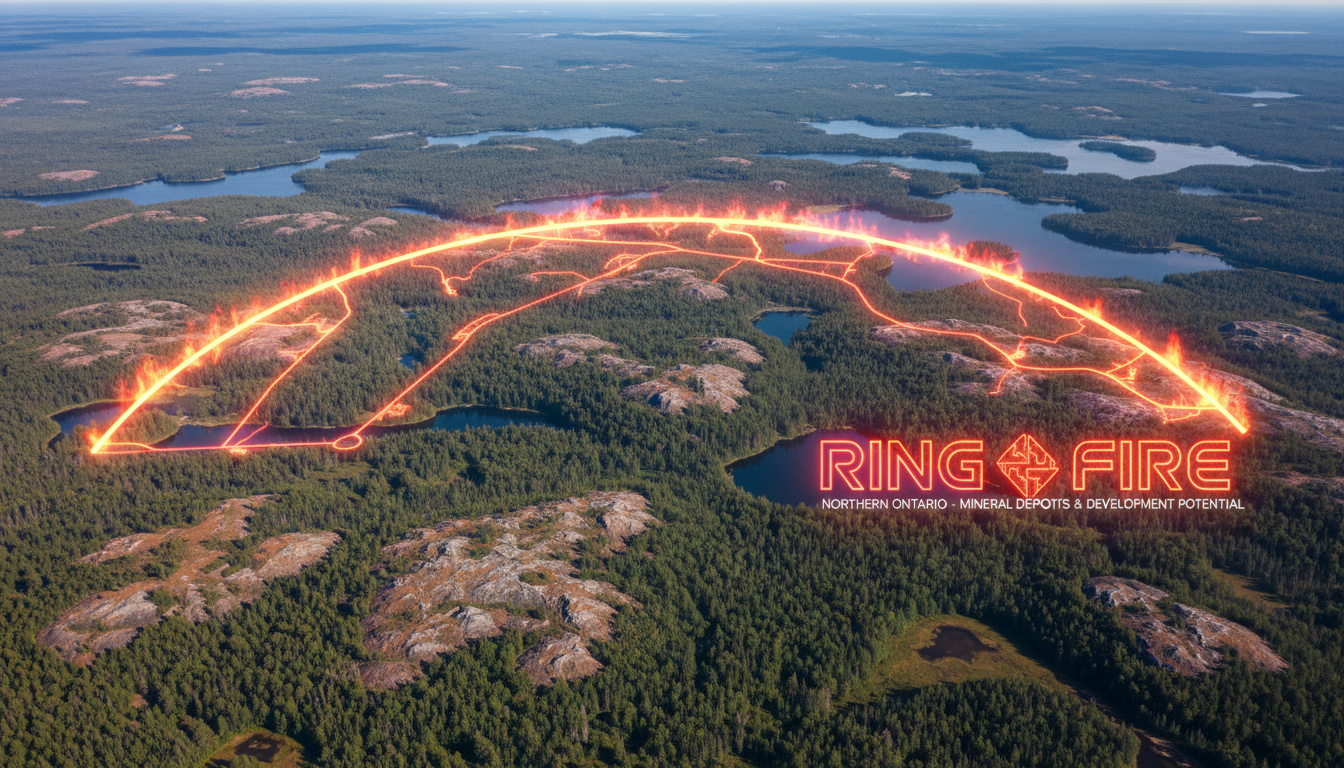
The Ring of Fire represents one of Canada’s most significant mineral discoveries, containing world-class deposits of chromite, nickel, and copper within a remote region of Northern Ontario.
Situated more than 500 kilometres northeast of Thunder Bay, this crescent-shaped zone spans approximately 5,000 square kilometres within the James Bay Lowlands. Discovered in 2007, the region has attracted sustained interest from major mining companies, provincial and federal governments, and First Nations communities, though development remains in advanced planning stages without active production mines.
Accessing these resources requires navigating complex geological, environmental, and infrastructural challenges that continue to shape the region’s future.
Where Is the Ring of Fire Located in Ontario?
The Ring of Fire occupies the McFaulds Lake Greenstone Belt, centred around coordinates 52°46′N 86°3′W, within the Mushkegowuk territory of the James Bay Lowlands. This location places it over 500 kilometres northeast of Thunder Bay and approximately 300 kilometres from the nearest permanent road network. The region currently lacks permanent all-weather road access, relying on winter roads and air transport for exploration activities.
- Discovered in 2007 by Noront Resources
- Contains world-class chromite deposits considered among the largest in North America
- Located over 500 km northeast of Thunder Bay in remote wilderness accessible primarily by winter roads
- Active mining claims cover approximately 8,000 square kilometres
- Infrastructure access remains the primary barrier to commercial development
- Multiple First Nations hold treaty rights and traditional territory claims over the region
- Potential economic impact estimated at $60 billion
| Fact | Details |
|---|---|
| Discovery Year | 2007 |
| Approximate Area | ~5,000 square kilometres |
| Geographical Shape | Crescent-shaped arc |
| Center Coordinates | 52°46′N 86°3′W |
| Distance from Thunder Bay | Over 500 km northeast |
| Geological Setting | McFaulds Lake Greenstone Belt |
| Primary Mineral | Chromite |
| Active Claim Area | ~8,000 km² |
| Provincial Investment | Over $278 million in exploration |
| Key Access Proposal | 344 km all-weather road from Geraldton |
| Territorial Context | Traditional territories of Marten Falls First Nation and others |
What Is the Ring of Fire in Ontario?
The Ring of Fire constitutes a massive mineral belt formed during the Neoarchean era, characterized by volcanic and intrusive rock formations that host significant concentrations of chromite and associated minerals. Ontario’s provincial government has designated the region as a strategic priority for critical minerals development, establishing a dedicated Secretariat in 2011 to coordinate environmental assessments and Aboriginal consultations.
Geological Formation
The region sits within the Superior Province of the Canadian Shield, specifically the McFaulds Lake Greenstone Belt. This geological formation dates back approximately 2.7 billion years and hosts volcanogenic massive sulphide deposits alongside layered intrusions containing chromite. The mineralization occurs primarily along a 20-kilometre strike zone, with deposits extending to depths of 200 metres in some locations.
Discovery Context
Prospector Richard Nemis and geologist Neil Novak of Noront Resources identified the initial chromite showings in 2007. Subsequent drilling revealed the Black Thor deposit, containing an estimated 72 megatonnes of chromite ore grading 42% chromium oxide (Cr₂O₃). This discovery triggered a staking rush that established the current claim boundaries covering significantly more area than the initial discovery zone.
The entire Ring of Fire sits on traditional territories of multiple First Nations, including Marten Falls First Nation, Webequie First Nation, and Neskantaga First Nation. These communities maintain treaty rights and consultation authority over any proposed development activities.
What Minerals and Resources Are Found in the Ring of Fire?
The region hosts diverse mineralization including chromite, nickel, copper, platinum group elements (PGEs), gold, zinc, and palladium. These deposits occur in distinct geological settings, with chromite dominating the western portion while nickel-copper-PGE concentrations appear in the eastern segments.
Chromite Deposits
Black Thor represents the flagship chromite deposit, with measured resources of approximately 72 megatonnes averaging 42% Cr₂O₃ across a 2-kilometre strike length. Additional chromite occurrences include Black Horse, Big Daddy, and Black Label. MetalQuest Mining acquired the ROF-1 property in December 2025, covering 20,800 hectares adjacent to these major deposits.
Nickel, Copper and Platinum Group Elements
Eagle’s Nest contains high-grade nickel-copper-PGE mineralization with over 15.7 million tonnes of resources. Wyloo Metals, an Australian company, holds the Eagle’s Nest project and has announced plans to commence construction in 2027 with production targeted for 2030. The nickel grades at Eagle’s Nest exceed typical global averages, making it a potentially significant source for battery metals.
Other Mineral Occurrences
Exploration has identified gold and zinc occurrences throughout the greenstone belt, though these remain secondary to the chromite and base metal deposits. The Vespa Complex, held by Juno Corp., represents an expanded exploration area covering 4,600 square kilometres as of January 2025.
Chromite serves as the only commercial source of chromium, an essential element for stainless steel production and emerging battery technologies. The Ring of Fire deposits could supply North American manufacturing with domestically sourced critical minerals.
The James Bay Lowlands contain significant wetland ecosystems and peatlands that function as carbon sinks. Environmental assessments indicate that large-scale mining operations could impact water systems affecting traditional hunting and fishing territories.
What Is the Current Status of Ring of Fire Development?
Development remains in the planning and permitting phase despite nearly two decades since discovery. No commercial mining operations currently exist, though several companies maintain active exploration programs and advanced project studies.
Active Projects and Corporate Holdings
Wyloo Metals controls Eagle’s Nest with a definitive timeline targeting 2027 for construction commencement and 2030 for first production. Juno Corp. holds the largest contiguous claim block at 4,600 square kilometres and conducts systematic exploration across the Vespa Complex. MetalQuest Mining entered the region in December 2025, acquiring the ROF-1 property for 2026 exploration planning following community engagement protocols.
Infrastructure Proposals
Access infrastructure remains the critical path item for development. A proposed 344-kilometre all-weather road from Geraldton would connect the region to the provincial highway network. Alternatively, KWG Resources has proposed a 330-kilometre railway from Exton to Nakina, connecting to the CN Rail network. The provincial government has invested over $278 million in exploration and planning, though final infrastructure decisions remain pending.
Indigenous Consultations
First Nations communities, particularly Marten Falls First Nation, maintain active involvement in development discussions. KWG Resources initiated pursuit of an “equal partnership” model with Marten Falls in 2017 for chromite processing and rail infrastructure. However, community opposition persists regarding rapid development timelines and potential impacts on traditional territories.
How Has Ring of Fire Development Progressed Over Time?
- : Noront Resources discovers chromite deposits in the McFaulds Lake area
- : Cliffs Natural Resources acquires Black Thor and Black Label deposits, calling them “premier chromite deposits in the world”
- : Ontario establishes the Ring of Fire Secretariat and invests over $278 million in exploration infrastructure
- : Cliffs announces $3.3 billion development plan including mine, road, and Sudbury smelter with $550 million initial investment
- : Cliffs suspends and abandons the project citing economic and political uncertainties; KWG Resources proposes 330 km rail line
- : KWG pursues equal partnership agreement with Marten Falls First Nation
- : Juno Corp. enters the region, eventually becoming the largest private claimholder
- : Federal government includes Ring of Fire in Canada’s Critical Minerals Strategy
- : Juno Corp. expands holdings to 4,600 km²
- : MetalQuest Mining acquires ROF-1 property (20,800 hectares)
- : Wyloo Metals targets construction commencement at Eagle’s Nest (projected)
- : Wyloo Metals targets production commencement (projected)
What Is Certain and Uncertain About the Ring of Fire’s Future?
| Established Information | Information That Remains Unclear |
|---|---|
| Discovered in 2007 by Noront Resources | Final route for permanent all-weather access (road versus rail) |
| Contains measured chromite resources exceeding 72 megatonnes at Black Thor | Completion dates for environmental assessment processes |
| Eagle’s Nest contains >15.7 million tonnes of high-grade nickel-copper-PGEs | Final agreements with all affected First Nations |
| Wyloo Metals plans construction in 2027 | Market conditions supporting $3.3+ billion capital investments |
| Juno Corp holds 4,600 km²; MetalQuest acquired ROF-1 in Dec 2025 | Provincial infrastructure funding commitments and timelines |
| Located within traditional territories of Marten Falls and other First Nations | Long-term environmental monitoring and mitigation requirements |
Why Does the Ring of Fire Matter for Ontario?
The region represents a potential $60 billion economic opportunity for Toronto-based mining finance and Northern Ontario communities. As a significant potential source of chromite, the region could reduce North American reliance on foreign chromium supplies for stainless steel manufacturing.
The development status carries implications for Canada’s critical minerals strategy and the global energy transition, particularly regarding nickel supplies for electric vehicle batteries. However, these economic potentials must balance against the protection of James Bay Lowlands ecosystems and the recognition of Indigenous treaty rights.
What Sources Inform Ring of Fire Research?
Geological data derives from the Ontario Ministry of Mines, Natural Resources Canada, and the Geological Survey of Canada. Corporate reporting from Wyloo Metals, Juno Corp., and MetalQuest Mining provides project-specific timelines and resource estimates. Indigenous perspectives and territorial information come from band council resolutions and community impact assessments.
Environmental research cited by Natural Resources Canada and independent geological surveys confirms the volcanic and intrusive nature of the greenstone belt formations.
What Is the Current Outlook for the Ring of Fire?
The Ring of Fire remains one of North America’s most significant undeveloped mineral provinces, holding world-class chromite and nickel deposits valued at approximately $60 billion. While Wyloo Metals has established a concrete timeline for Eagle’s Nest production by 2030 and recent claim acquisitions by Juno Corp. and MetalQuest Mining indicate continued industry interest, infrastructure challenges and First Nations consultation processes leave the region’s immediate future uncertain. The coming years will determine whether provincial infrastructure commitments and community agreements can align to unlock these critical mineral resources.
Frequently Asked Questions About the Ring of Fire
Who discovered the Ring of Fire in Ontario?
Noront Resources identified the initial chromite discoveries in 2007, with prospector Richard Nemis and geologist Neil Novak credited with the find.
Is there an interactive map available for the Ring of Fire?
Yes, the Ontario Ring of Fire Alliance and mining companies including MetalQuest provide detailed mapping resources showing claim boundaries and deposit locations.
What is chromite used for?
Chromite is the only commercial source of chromium, essential for manufacturing stainless steel and potentially important for emerging battery technologies.
Which First Nations are involved in Ring of Fire development?
Marten Falls First Nation, Webequie First Nation, and Neskantaga First Nation hold treaty rights over the territory, with Marten Falls particularly involved in infrastructure discussions.
When will the Ring of Fire begin production?
Wyloo Metals has announced plans to begin construction at Eagle’s Nest in 2027 with production targeted for 2030, though this timeline depends on infrastructure and permitting resolution.
How does the Ring of Fire compare to other mining regions?
The chromite deposits rank among the largest in North America, while the Eagle’s Nest nickel deposit contains grades exceeding many global comparables.
What infrastructure is needed to access the Ring of Fire?
Current proposals include a 344-kilometre all-weather road from Geraldton or a 330-kilometre railway connecting to CN Rail near Nakina.
Related stories





Hannah Walsh covers federal and provincial politics and public policy for Canada Scope.