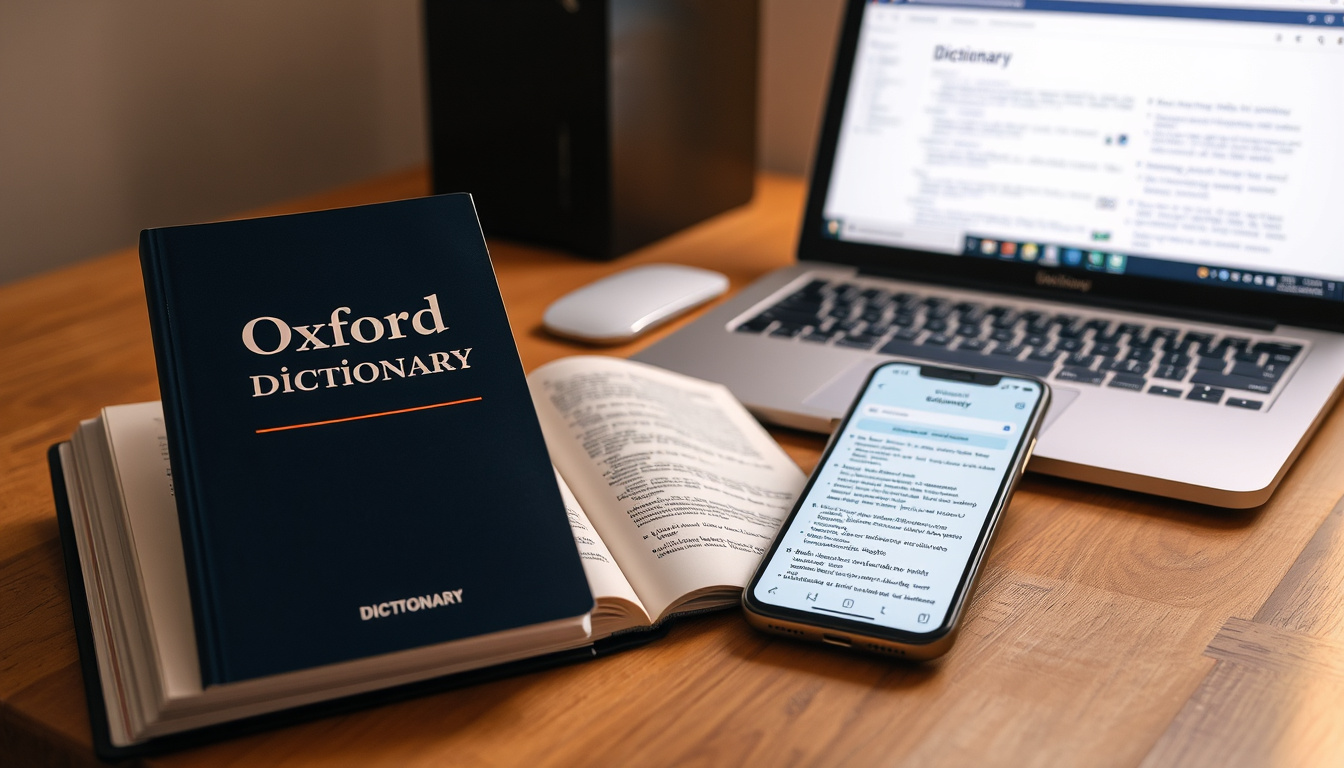
Anyone who has searched for a word and landed on six different products all named “Oxford Dictionary” knows the confusion is real. The Oxford English Dictionary (OED), the Oxford Dictionary of English, and the Oxford Advanced Learner’s Dictionary are separate tools with separate prices and platforms. Pick the wrong one and you could pay for historical depth you don’t need, or miss the learner tools you do.
Publisher: Oxford University Press (Oxford Languages) · OED entries: 600,000+ (OED official site) · Standard price: £65 / €85 / $99 per year (OED subscription plans) · App model: free download with in-app purchases (Apple App Store listing)
Quick snapshot
- The OED is the most comprehensive English dictionary (OED official site)
- The premium app provides offline access after dictionaries are downloaded (MobiSystems product page)
- The app includes 18 Oxford dictionaries (MobiSystems product page)
- OED Online is updated continuously (OED official site)
- Exact completion date of the OED 3rd edition
- Whether a full print edition of the OED will continue
- Exact number of active free online users
- How long app prices stay stable across different App Store regions
- 1884: first fascicle published (OED history page)
- 2000: OED Online launched (OED history page)
- 2010–present: third edition work ongoing, fully digital (OED history page)
- Expect new words and revisions to keep arriving on a rolling basis (OED official site)
- Premium app features remain gated behind subscription or one-time purchase (MobiSystems product page)
- Library and university access remains a legitimate route for OED Online (OED official site)
The pattern is clear: “Oxford Dictionary” is a family of products, not a single app or book.
| Label | Value |
|---|---|
| Publisher | Oxford University Press (OUP) |
| Primary Dictionary | Oxford English Dictionary (OED) |
| First Published | 1884 (OED history page) |
| Latest Online Update | Continuous (OED official site) |
| App Availability | iOS, Android, Windows (MobiSystems product page) |
| Total Entries (OED) | 600,000+ (OED official site) |
| Price Range | $69–$200+ per year online; app in-app purchases from $4.99 (Adapty paywall database) |
What is the price of the Oxford Dictionary?
How much does an OED subscription cost?
- OED Online personal subscription: about £65 per year (OED official site)
- App Store in-app purchases: Oxford Dictionary Premium at $39.99, with Oxford Dictionary of English options at $4.99 and $9.99 (Apple App Store US listing)
- Independent paywall data shows subscription patterns around $4.99 weekly, $2.99 monthly and $9.99–$39.99 annually, though market varies (Adapty paywall database)
- Regional App Store prices shift too: the France listing shows rates from €9.99 to €45.99 depending on the tier (Apple App Store France listing)
The range exists because the app and the OED website are different products. The app subscription unlocks an Oxford-languages bundle; the OED online subscription unlocks the full historical dictionary. They are not interchangeable.
Where can I buy a print edition?
- Pocket editions start around $15.
- The complete OED print set has been listed at around $175.
- Print editions do not receive the continuous updates that OED Online receives.
For most readers, print is now a display or reference-object purchase. The online edition keeps moving, while a printed set cannot capture new words.
The subscription is the real product. The app’s free tier is a trial; the value sits in the full 18-dictionary bundle and offline access (MobiSystems product page).
The pattern: if you are paying, make sure you know whether you are paying for the OED website or the app. Each answers a different question.
How do I access the Oxford Dictionary online?
Is the Oxford Dictionary free to use online?
- Public libraries and universities often provide free access to OED Online through subscriptions (OED official site)
- The free app tier includes definitions, examples, Word of the Day, favourites, recent searches, camera search and voice search (MobiSystems product page)
- Without an institution, the practical free route is the app’s free tier, not the full OED database.
The free route exists, but it is usually mediated by a library, university or school.
How does the OED website work?
- OED.com is a research interface with timelines, etymologies and quotations (OED official site)
- Entries are revised on a rolling basis rather than waiting for a print edition.
- Search results show how a word’s meaning has shifted across recorded history.
What this means: if nobody is paying for OED access on your behalf, you are the subscriber.
How do I download the Oxford Dictionary app?
What is the best Oxford Dictionary app?
- The Oxford Dictionary app is free to download and uses in-app purchases for premium features (Apple App Store US listing)
- MobiSystems says the app contains 18 Oxford dictionaries (MobiSystems product page)
- Premium adds offline mode, audio pronunciations, the full English Thesaurus, regular updates and an ad-free experience (MobiSystems product page)
For most individual users, the Oxford Dictionary app is the most practical starting point: one download, one upgrade path, offline dictionaries after purchase. The full OED online has more historical depth but targets research.
Is the app available for PC?
- MobiSystems lists iOS, Android and Windows among its supported platforms (MobiSystems product page)
- Desktop users who want the full OED typically use OED.com in a browser.
- A dedicated full-OED Windows application is not the standard route.
In practice, the desktop experience is split. The OED website is the serious research tool; the Oxford Dictionary app is a mobile reference.
App subscriptions renew automatically unless you disable auto-renewal at least 24 hours before the renewal date (Apple App Store Bermuda listing).
Is there an Oxford Dictionary PDF?
Are there legal free PDF versions?
- There is no official full-text PDF of the entire OED for general sale.
- Free PDFs advertised online are often pirated, low-quality scans or abridged editions.
- Legitimate free access comes through library subscriptions, not downloadable PDFs.
A free PDF may still be an old public-domain edition, which is not the current dictionary.
What is the difference between PDF and print?
- PDF: static, hard to search, no updates.
- Print: authoritative but dated after each new edition.
- Online: continuously updated but requires a subscription.
The catch: if someone offers you a free OED PDF, you are almost certainly looking at an old edition or a copy without the publisher’s updates.
Which version of the Oxford Dictionary should I choose?
What is the difference between the OED and the Oxford Dictionary of English?
- OED: a historical record of English, tracing usage over time (OED official site)
- Oxford Dictionary of English: reflects current English usage and works as a desk dictionary.
- Oxford Advanced Learner’s Dictionary: designed for non-native speakers, with simpler definitions and learning tools (Oxford Languages)
The OED is closer to an archive; the Oxford Dictionary of English is closer to a working desk reference.
Which is best for learning English?
- OALD is explicitly built for ESL students (Oxford Languages)
- The OALD app includes pronunciation, grammar support and examples (MobiSystems product page)
- The OED is better for advanced research than for daily language learning.
The implication: for a student learning English, OALD is the safer buy because its definitions are written with learner proficiency in mind.
Oxford Dictionary comparison at a glance
Three products, one warning: each column below is a different tool, and the best value depends on which row matches your use case.
| Feature | Oxford English Dictionary | Oxford Dictionary of English | Oxford Advanced Learner’s Dictionary |
|---|---|---|---|
| Best for | Historical and academic research | Everyday use and writing | English learners and ESL students |
| Content focus | Records usage across centuries with quotations | Current English definitions | Simple definitions, grammar and pronunciation |
| Typical access | Subscription on OED.com | App in-app purchase or print | App with free tier and premium upgrade |
| Offline support | Online research tool | Premium app supports offline | Premium app supports offline |
| Update model | Continuously updated online | App updates; print editions lag | App updates; new editions periodically |
Oxford Dictionary specifications
Eight specs, one pattern: the official product line is broader than a single app, and “Oxford Dictionary” is a family name, not one SKU.
| Specification | Value |
|---|---|
| Product family | OED, Oxford Dictionary of English, OALD, Oxford Concise |
| Publisher | Oxford University Press |
| Primary dictionary | Oxford English Dictionary |
| First published | 1884 |
| Current edition | Third edition (digital) |
| Total entries | 600,000+ |
| App availability | iOS, Android, Windows |
| Offline mode | Premium app includes offline dictionaries |
| Price signal | $39.99 Premium in-app; ODE options at $4.99 and $9.99; OED Online about £65 per year |
Pros and cons at a glance
Upsides
- Official Oxford University Press content, not a scraper dictionary.
- Premium app works offline after download (MobiSystems product page)
- OED Online is continuously updated (OED official site)
- Several product levels fit learners, writers and researchers.
Downsides
- Costs add up if you buy more than one format.
- The full OED can be more than a casual user needs.
- No official full OED PDF for a one-time purchase.
- The free app is limited and prompts upgrades.
How to choose and use your Oxford Dictionary in five steps
- Set your task. Academic research, everyday writing and ESL study call for different dictionaries.
- Match the product. OED for research, Oxford Dictionary of English for writing, OALD for learning English.
- Start with free access. Try the app’s free tier or check whether your library subscribes to OED Online (OED official site).
- Check offline needs. If you travel or study without reliable internet, Premium adds offline dictionaries (MobiSystems product page).
- Set a renewal reminder. Auto-renewal is on by default unless you disable it at least 24 hours before the renewal date (Apple App Store Bermuda listing).
The pattern: each step eliminates a wrong product before you spend money.
A short history of the Oxford Dictionary
Seven milestones, one through-line: the OED started as a Victorian research project and became a continuously updated digital database.
| Period | Milestone |
|---|---|
| 1857 | Philological Society calls for a new English dictionary (OED history page) |
| 1884 | First fascicle published (OED history page) |
| 1928 | First edition completed (OED history page) |
| 1989 | Second edition published (OED history page) |
| 2000 | OED Online launched (OED history page) |
| 2010–present | Third edition work ongoing, fully digital (OED history page) |
What we know for sure, and what is still unclear
Confirmed facts
- OED is the most comprehensive English dictionary (OED official site)
- Oxford University Press publishes multiple English dictionaries (Oxford Languages)
- OED is available by subscription online (OED official site)
- The premium app provides offline access (MobiSystems product page)
What’s still unclear
- Exact completion date for the OED’s third edition
- Future of full print editions of the OED
- Exact number of active free online users
- How long Apple’s one-time Premium price of $39.99 will remain stable across all markets
What the publisher and store listings say
Premium unlocks all 18 dictionaries, complete audio pronunciations, offline mode, the full English Thesaurus, regular updates and an ad-free experience.
MobiSystems product page (Oxford Dictionary app developer)
App subscriptions may be billed weekly, monthly or annually depending on the selected plan and local App Store pricing matrix.
Apple App Store (Bermuda listing)
The OED is the definitive record of the English language.
Oxford English Dictionary official site
The bottom line: choosing your Oxford Dictionary
Strip the brand apart and you have three different tools wearing one name. The OED online is a historical research database; the Oxford Dictionary of English is a desk dictionary; the Oxford Advanced Learner’s Dictionary is a learning system. For most people paying out of pocket, the smartest buy is a mobile app subscription with offline access, not an OED subscription built for institutional research. For students, the OALD app gives the most learner-focused value. For writers and everyday reference, the Oxford Dictionary of English app or the free tier is enough. For a UK-based reader, the decision between the £65 OED subscription and a £19.99-level app plan is a decision between depth and daily usefulness.
apps.apple.com, reddit.com, play.google.com, academic.oup.com
Frequently asked questions
How do I cite the Oxford English Dictionary in my work?
Use the publisher’s citation guidance. A standard format is: Oxford English Dictionary, Oxford University Press, edition, entry word, access date, and the URL. The OED site provides entry-level citation details (OED official site).
Does the Oxford Dictionary include pictures or illustrations?
OED.com is text-driven and focuses on definitions, etymologies and quotations. The mobile app contains 18 Oxford dictionaries, with store pages emphasising text, pronunciations and search tools rather than illustrations (MobiSystems product page).
Can I use the Oxford Dictionary app with screen readers?
Store listings do not publish a detailed accessibility statement for the app. The safest route is to download the free tier and test it with your device’s built-in screen reader before paying (Apple App Store listing).
What is the history of the Oxford Dictionary?
The project began in 1857 with the Philological Society’s call for a new English dictionary. The first fascicle appeared in 1884, the first edition was completed in 1928, the second in 1989, and OED Online launched in 2000 (OED history page).
How often are new words added to the OED?
OED Online is updated continuously. The publisher revises and expands entries on a rolling basis rather than waiting for a new print edition (OED official site).
Does the Oxford Dictionary app save my search history?
Yes. The free version includes recent searches, favourites and advanced search tools such as camera and voice search (MobiSystems product page).
Related stories



Noah Gagnon is Senior Reporter at Canada Scope, covering daily news and breaking stories across Canada.