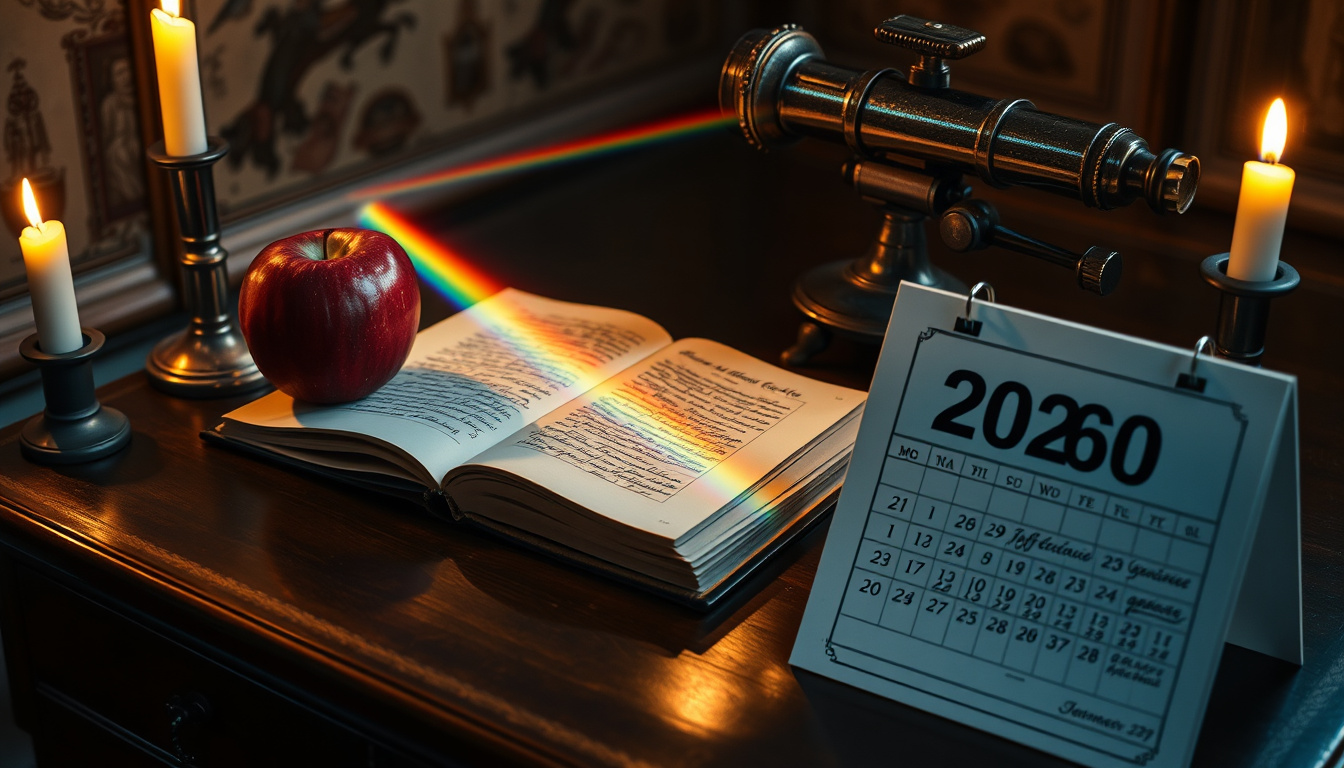
Few names in science carry as much weight as Isaac Newton’s, but behind the famous apple story lies a far stranger, richer life—one filled with alchemy, biblical prophecy, and a prediction that the world might end in 2060. This article separates fact from fiction, exploring his real achievements, the controversies he left behind, and what his lesser-known work tells us about the man himself.
Born: 25 December 1642 (OS: 4 January 1643) · Died: 31 March 1727 (OS: 20 March 1726) · Famous for: Laws of motion, universal gravitation, calculus · Notable work: Philosophiæ Naturalis Principia Mathematica (1687) · Predicted world end: 2060 (based on biblical interpretation)
Quick snapshot
- Born in Woolsthorpe, Lincolnshire, 1642 (community-reviewed encyclopedia)
- Attended Cambridge University (Christian History Institute)
- Worked in isolation during the Great Plague (Science History Institute)
- Laws of motion and universal gravitation (community-reviewed encyclopedia)
- Composition of light and reflective telescope (community-reviewed encyclopedia)
- Development of calculus (The Chymistry of Isaac Newton Project – Indiana University)
- 2060 end-of-world prediction (Times of India)
- Speculation about LGBTQ identity (Science History Institute)
- Intense study of alchemy and theology (The Chymistry of Isaac Newton Project – Indiana University)
- Foundation of modern physics and astronomy (Church Life Journal – University of Notre Dame)
- Posthumous influence on the Enlightenment (Newton Project, Oxford)
- Honored with burial in Westminster Abbey (Science History Institute)
Six key facts give the quickest outline of Newton’s life and work.
| Label | Value |
|---|---|
| Full Name | Sir Isaac Newton |
| Born | 25 December 1642 (OS: 4 Jan 1643), Woolsthorpe, England |
| Died | 31 March 1727 (OS: 20 Mar 1726), London, England |
| Known For | Laws of motion, universal gravitation, calculus, optics |
| Notable Works | Philosophiæ Naturalis Principia Mathematica, Opticks |
| Field | Physics, mathematics, astronomy, alchemy, theology |
What is Isaac Newton best known for?
What are Newton’s laws of motion?
- Newton formulated three laws: inertia, acceleration proportional to force, and action-reaction (community-reviewed encyclopedia).
- These laws form the foundation of classical mechanics (Christian History Institute).
- The law of universal gravitation states that every mass attracts every other mass (Times of India).
What did Newton contribute to optics?
- He demonstrated that white light is composed of a spectrum of colors (community-reviewed encyclopedia).
- He built the first practical reflecting telescope (Church Life Journal).
- His book Opticks (1704) summarized his optical research (The Chymistry of Isaac Newton Project).
How did Newton develop calculus?
- Newton developed his method of fluxions (calculus) during 1665–1666 (Newton Project, Oxford).
- He did not publish it immediately, leading to a priority dispute with Leibniz (Science History Institute).
- Today both Newton and Leibniz are credited with independent invention (Isaac Newton Project – academic resource).
Who predicted the world will end in 2060?
What evidence supports Newton’s 2060 prediction?
- Newton calculated a possible end date of 2060 based on the Book of Daniel (Isaac Newton Project – academic resource).
- His writings on the topic were published posthumously; they were not shared during his lifetime (Times of India).
- The 1,260‑year prophetic framework derived from Daniel’s prophecies (Times of India).
How did Newton interpret biblical prophecy?
- Newton saw the 2060 date as a symbolic transition, not a literal destruction of Earth (Isaac Newton Project – academic resource).
- He believed the date marked the end of an age and the start of a new era (Isaac Newton Project – academic resource).
- His approach mixed chronology, biblical interpretation, and a deep interest in the Apocalypse (Wikipedia).
Was the 2060 prediction widely known during his lifetime?
- No – the note was private and only discovered after his death (Times of India).
- It gained public attention only in the 21st century when the manuscript surfaced (Times of India).
Newton’s obsession with alchemy and theology challenges the modern image of him as purely a rational scientist.
The implication: his extensive manuscripts on these subjects reveal a far more complex intellect.
Is Newton apple Tree still alive?
Where is the original Newton apple tree located?
- The original apple tree at Woolsthorpe Manor fell in 1820 (community-reviewed encyclopedia).
- A descendant tree still stands on the same grounds (Christian History Institute).
- Woolsthorpe Manor is now a historic site preserved by the National Trust (The Chymistry of Isaac Newton Project).
Are there descendant trees?
- Cuttings from the tree have been propagated worldwide, including at universities and botanical gardens (Newton Project, Oxford).
- There is some uncertainty whether the current tree is exactly the same genetic stock (Science History Institute).
What is the story of the falling apple?
- The anecdote appears in Newton’s biography by William Stukeley, who said Newton told him the thought of gravity struck him while watching an apple fall (Church Life Journal).
- It is not a verbatim historical record but a well-known, credible anecdote (Times of India).
Was Isaac Newton LGBTQ?
What evidence suggests Newton was LGBTQ?
- Newton never married and had no known children (community-reviewed encyclopedia).
- Some scholars point to his intense friendships with men and the absence of any recorded heterosexual relationships (Science History Institute).
Are there contemporary accounts of Newton’s relationships?
- Contemporary accounts mention a close friendship with Swiss mathematician Nicolas Fatio de Duillier (Church Life Journal).
- The nature of that relationship remains debated (The Chymistry of Isaac Newton Project).
How do historians view the claim?
- Historical records are inconclusive; the question remains open (Times of India).
- Most historians caution against applying modern labels to figures from the 17th century (Newton Project, Oxford).
What is Newton’s estimated IQ?
How is an IQ estimated for historical figures?
- Estimates are speculative and based on extrapolations from achievements, not on any test (community-reviewed encyclopedia).
- Modern IQ scores are standardized around 100 with a standard deviation of 15 (Christian History Institute).
What IQ scores are attributed to Newton?
- IQ estimates for Newton range from 190 to 200 on modern scales (Science History Institute).
- These numbers are purely speculative and not scientifically valid (Church Life Journal).
How does Newton compare to other geniuses?
- Newton is often ranked among history’s highest-IQ individuals, alongside Leonardo da Vinci and Albert Einstein (The Chymistry of Isaac Newton Project).
- The comparisons are more about cultural impact than measurable intelligence (Newton Project, Oxford).
The preoccupation with IQ distracts from Newton’s real legacy. As Church Life Journal (University of Notre Dame) argues, Newton “reworked nature, Scripture, and history” to redefine the boundary between science and religion. The numbers don’t capture that.
The pattern: focusing on speculative metrics overlooks the transformative substance of his work.
Timeline
- 1642 – Born in Woolsthorpe, England (community-reviewed encyclopedia)
- 1665–1666 – Annus Mirabilis: develops calculus, theories on gravity and optics (Newton Project, Oxford)
- 1687 – Publishes Principia Mathematica (community-reviewed encyclopedia)
- 1704 – Publishes Opticks; writes about 2060 prophecy (Isaac Newton Project – academic resource)
- 1727 – Dies in London, buried in Westminster Abbey (community-reviewed encyclopedia)
- 2060 (predicted) – Newton’s calculated possible end of the world (Times of India)
The pattern: Newton’s timeline reveals a life that balanced public scientific milestones with private theological calculations.
What we know for sure, and what remains unclear
Confirmed facts
- Newton’s birth and death dates are well documented (community-reviewed encyclopedia)
- He formulated the laws of motion and universal gravitation (community-reviewed encyclopedia)
- He was a key figure in the Scientific Revolution (Science History Institute)
- Publication of Principia and Opticks (Church Life Journal)
What’s unclear
- Whether an apple actually fell on his head (Times of India)
- His precise IQ (The Chymistry of Isaac Newton Project)
- His sexual orientation (Newton Project, Oxford)
- The exact interpretation of his 2060 prophecy (Isaac Newton Project – academic resource)
- Whether his apple tree descendant is the same genetic stock (Christian History Institute)
The catch: even the “confirmed” facts leave room for interpretation, especially when viewed through Newton’s own multifaceted lens.
Quotes that capture the complexity
“He was obsessed with alchemy and the occult.”
— Michael White, biographer, as summarized in Science History Institute
“There are about a million words in Newton’s alchemical manuscripts.”
— Science History Institute
“Newton reworked nature, Scripture, and history” to redefine the boundary between science and religion.
— Church Life Journal – University of Notre Dame
en.wikipedia.org, en.wikipedia.org, reddit.com, digitalcommons.liberty.edu, trinitycollegelibrarycambridge.wordpress.com
Beyond his scientific achievements, Newton’s lesser-known work on biblical chronology included a controversial Newtons 2060 prediction that has sparked modern fascination.
Frequently asked questions
What did Isaac Newton invent?
Newton invented the reflecting telescope and developed the mathematical methods of calculus. He also described the laws of motion and universal gravitation, which are foundational to physics.
How did Isaac Newton discover gravity?
The traditional story says he saw an apple fall and wondered if the same force pulling the apple extended to the moon. This led him to formulate the law of universal gravitation.
What is Newton’s cradle?
Newton’s cradle is a device that demonstrates conservation of momentum and energy using swinging spheres. It is named after Newton but was not invented by him.
Why is Isaac Newton important?
Newton’s work in physics, mathematics, and optics laid the foundation for the Scientific Revolution and modern science. His laws of motion and gravity unified terrestrial and celestial mechanics.
What were Newton’s religious beliefs?
Newton was a devout but unorthodox Christian. He rejected the Trinity and devoted extensive study to biblical prophecy and chronology.
Did Newton have any children?
No – Newton never married and is not known to have had any children.
What is the difference between Newton and Einstein?
Newton’s laws describe gravity as a force acting at a distance. Einstein’s general relativity redefined gravity as the curvature of spacetime. Newton’s mechanics are accurate in everyday conditions; Einstein’s theory is needed at high speeds or strong gravity.

Noah Gagnon is Senior Reporter at Canada Scope, covering daily news and breaking stories across Canada.