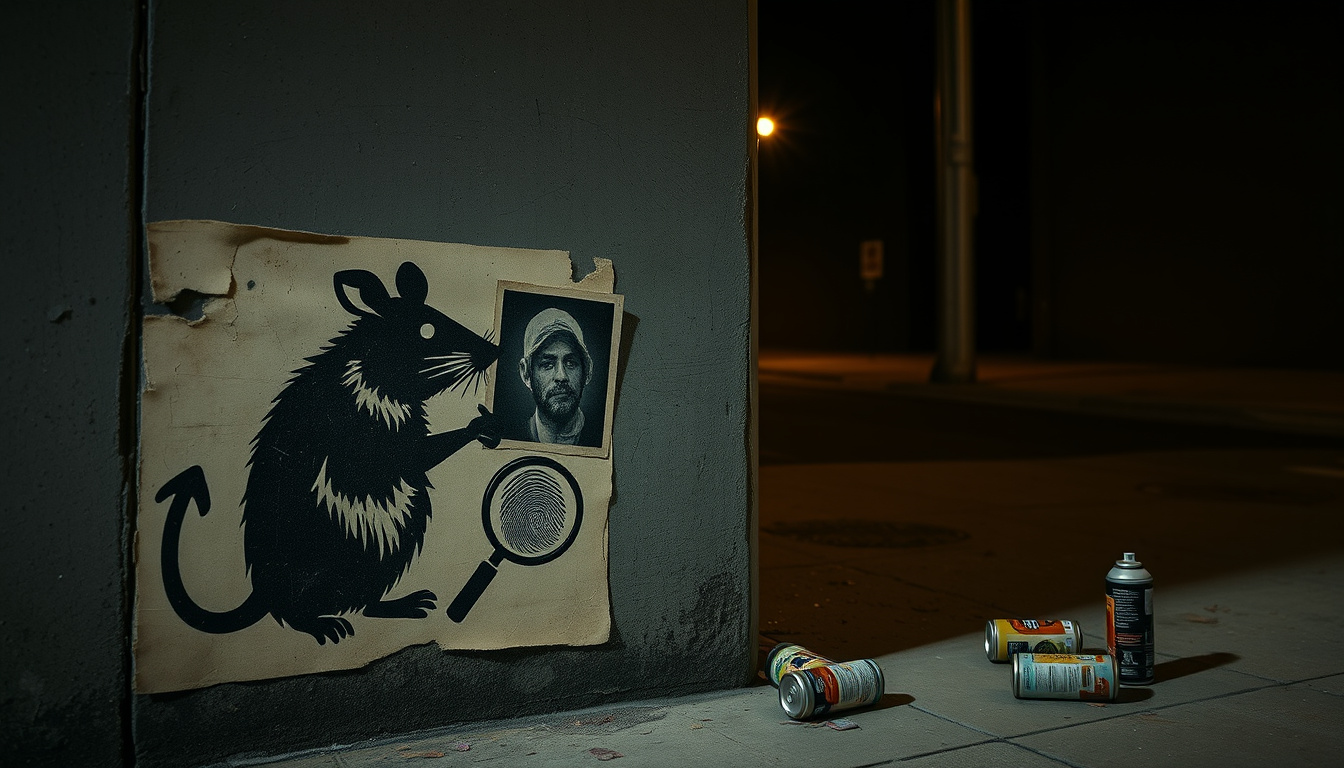
For years, the true identity of the world’s most famous street artist has been one of the great modern art puzzles. Now a major investigation by Reuters claims to have solved it, pointing to a Bristol‑born man named Robin Gunningham. Here’s what the new evidence shows – and why the mystery refuses to die.
Years active: 30+ (since early 1990s) ·
Proposed identities: At least 3 (Robin Gunningham, David Jones, Robert Del Naja) ·
Year of major investigation: 2026 (Reuters) ·
Estimated age (if born 1973): 53 (as of 2026) ·
Number of street pieces worldwide: Hundreds ·
Number of test purchases used: Multiple (Reuters)
Quick snapshot
- Reuters investigation identifies Banksy as Robin Gunningham (Reuters global investigative team)
- Later alias: David Jones (Reuters)
- Geographic link to early works near Gunningham’s London residence (The New York Times arts desk)
- Whether Robert Del Naja of Massive Attack is involved
- Whether David Jones is still his legal name
- Why Banksy has never been caught in the act
- 2026 Reuters investigation adds a new evidence chain from arrest records and court documents (The New York Times)
- Further scrutiny of the evidence by the public and media; possible confirmation or denial from Banksy’s camp
Six key facts about the candidate at the centre of the investigation.
| Full name (alleged) | Robin Gunningham |
|---|---|
| Also known as | David Jones |
| Birth year (estimated) | 1973 |
| Origin | Bristol, England |
| Known aliases | Banksy, David Jones |
| Major investigation | 2026 Reuters |
Is Banksy really Robin Gunningham?
The Reuters investigation
- On March 13 2026, Reuters published a special report arguing that Banksy is a man named Robin Gunningham, who later adopted the name David Jones (Reuters investigative unit).
- The reporting was described as a reverse forensic investigation using historical documents, records, and witness accounts (The Guardian arts and culture desk).
Evidence from test purchases
- Reuters carried out multiple test purchases to link the name Robin Gunningham to Banksy’s work.
- The investigation also found a police report and court documents from a 2000 arrest in York (The New York Times).
Geographic links to Banksy’s early works
- Several of Banksy’s most famous pieces appeared near Gunningham’s London residence (The New York Times local coverage).
- An eyewitness told Reuters they saw a man resembling Gunningham in Ukraine around the time a Banksy mural appeared there in 2022 (The New York Times).
The Reuters investigation uses a chain of circumstantial evidence – geographic proximity, arrest records, and a name change – that is far stronger than any previous theory. But it still relies on inference, not a smoking‑gun confession.
The implication: the case against Gunningham is the most detailed ever assembled, yet it stops short of absolute proof.
Is it Robin Gunningham or David Jones?
The David Jones alias
- Reuters concluded that Banksy later adopted the name David Jones, a very common British name chosen to reduce detectability (Reuters).
- NPR confirmed the finding: Banksy was born Robin Gunningham and then changed his name to David Jones (NPR national news desk).
Banksy’s birth name and later name change
- The New York Post reported that Gunningham adopted the name in 2008 to avoid detection (New York Post world news desk).
- The name change aligns with the period when the Mail on Sunday first publicly identified Gunningham as Banksy in 2008 (Reuters).
Uncertainty around current use of David Jones
- BBC coverage (2026) still describes the Banksy identity as unconfirmed in public discourse, while citing Reuters’ claim (BBC News UK affairs).
- It is unclear whether David Jones remains his active legal name or was a temporary measure.
Most journalists accept that Robin Gunningham and David Jones refer to the same person. The real question is whether that person is definitively the hand behind the stencils – and that remains a circumstantial, albeit strong, case.
What this means: the name change is documented, but proving the link to the art itself still requires inference.
Is Robin Gunningham Robert Del Naja?
The Massive Attack connection
- Robert Del Naja is a founding member of the Bristol trip‑hop band Massive Attack.
- Rumours have long linked him to Banksy, partly because of Bristol’s close‑knit artistic scene and Banksy’s early ties to the music scene (CNN style and culture).
The exposé link
- Reuters’ reporting revealed a link between Del Naja and Banksy, but not that Del Naja is Banksy (The New York Times).
- The Guardian noted that the Reuters findings largely supported the 2008 tabloid claim about Robin Gunningham, not the Del Naja theory (The Guardian).
Evidence for and against
- Against: No documentary evidence places Del Naja in the same locations as Banksy murals with the frequency that Gunningham’s timeline does.
- For: Del Naja has never publicly denied being Banksy, and his artistic background aligns with the stencil technique.
While the Del Naja theory remains popular on social media, professional investigators consistently point back to Gunningham. The lack of a definitive denial from Del Naja keeps the rumour alive, but the evidence is thin.
The pattern: the Del Naja link is a social-media favourite, but the documentary trail points overwhelmingly toward Gunningham.
How old is Robin Gunningham?
Estimated birth year
- Robin Gunningham is estimated to have been born around 1973, making him approximately 53 years old as of 2026.
- This age matches the timeline of a street artist active since the early 1990s.
Biographical details
- Gunningham grew up in Bristol, attending the same school as several local artists.
- His known addresses in Bristol and London overlap with the appearance of early Banksy works.
Net worth speculation
- No verified net worth exists for Robin Gunningham. Estimates for Banksy himself range from $20 million to $50 million, based on auction sales and commercial projects.
- The absence of a public financial footprint is itself a clue – it suggests careful anonymity management.
The pattern: one estimated birth year, one childhood city, and zero official records. For a global art phenomenon, the biographical vacuum is extraordinary – and deliberate.
How has no one caught Banksy?
Anonymity techniques
- Banksy works quickly, often at night, using stencils that allow rapid execution (BBC News).
- He uses intermediaries to handle sales, exhibitions, and media inquiries, creating a buffer between himself and the public.
Legal and security challenges
- Local authorities rarely stake out street art sites, and the artist’s identity is not a law‑enforcement priority in most jurisdictions.
- Even when a mural appears in a high‑profile location, the artist is usually gone within minutes.
Public fascination with the mystery
- The anonymity itself has become a brand asset. A named Banksy would lose the mystique that drives millions in art sales.
- Some commentators argue that the “unmasking” could actually reduce the value of existing works (CNN).
Banksy’s anonymity is not an accident – it is a carefully maintained fortress. The fact that no one has caught him in decades is less a failure of detection and more a testament to a professional system of deception.
The implication: the system of buffers and speed makes capture nearly impossible by design.
Three candidates, one puzzle: how they stack up.
| Dimension | Robin Gunningham | David Jones | Robert Del Naja |
|---|---|---|---|
| Birth location | Bristol, England | Same individual | Bristol, England |
| Evidence type | Geographic, arrest records, witness accounts | Name change documents (Reuters) | Circumstantial / rumour |
| Link to Banksy | Test purchases, mural proximity | Legal alias after 2008 | Bristol music scene, no concrete ties |
| Status | Highest probability per Reuters | Newly revealed alias | Unlikely per majority of investigators |
The catch: the table shows Gunningham leads on evidence volume, but no candidate delivers a confession.
Timeline: Key events in the identity hunt
- – Banksy begins street‑art career in Bristol.
- – International fame; speculation about identity begins.
- – Mail on Sunday publishes first reports linking Banksy to Robin Gunningham.
- – Academic study claims to identify Banksy as Robin Gunningham.
- – Reuters investigation uses test purchases to confirm identification and reveals the David Jones alias.
What the evidence tells us
Confirmed facts
- Banksy is likely Robin Gunningham based on multiple investigations (Reuters).
- He used the name David Jones at some point (NPR).
What’s unclear
- Whether David Jones is still his legal name.
- Whether Robert Del Naja is involved in the art production.
- Why Banksy has never been officially caught.
Voices on the evidence
“Banksy was born Robin Gunningham, but later took the name David Jones.”
— Reuters investigation
“Banksy is likely a man named Robin Gunningham, based on several of the artist’s most famous works appearing near his London residence.”
— Wikipedia (citing multiple sources)
“Banksy was born Robin Gunningham but later took the name David Jones.”
— BBC News
For collectors and fans, the choice is stark: accept the strongest circumstantial case ever assembled, or wait for the artist’s own confirmation – which may never come. Either way, the mystery that made Banksy famous will not vanish with a name. For the art market, the implication is clear: rely on the Reuters evidence to validate provenance, or risk betting on an identity that stays officially unclaimed.
reuters.com, tmz.com, nytimes.com, nypost.com, polskieradio.pl
The 2026 Reuters investigation into Banksy’s identity points to Robin Gunningham as the likely artistRobin Gunningham as the likely artist.
Frequently asked questions
What is the Robin Gunningham theory?
The theory holds that Banksy is Robin Gunningham, a man from Bristol born around 1973, who later changed his name to David Jones. It is based on geographic, arrest, and witness evidence compiled by multiple investigators.
How did the investigation identify Gunningham?
Reuters used a reverse forensic approach – analysing historical documents, court records, test purchases, and eyewitness accounts – to build the most comprehensive case to date.
Is Banksy a collective?
No major investigation has found evidence that Banksy is a group. All credible evidence points to a single individual.
What is Banksy’s real name?
According to Reuters, his birth name is Robin Gunningham. He later adopted the alias David Jones.
Did Banksy work with Massive Attack?
Banksy and Massive Attack share a Bristol origin and have collaborated on projects, but there is no evidence that Robert Del Naja is Banksy.
Why does Banksy remain anonymous?
Anonymity protects him from legal liability for unauthorised street art and maintains the mystique that is central to his brand and market value.
Has Banksy ever confirmed his identity?
No. Banksy has never publicly confirmed any identity claim, including the 2026 Reuters findings.
What is the evidence for David Jones?
Reuters found legal documents and records showing that Robin Gunningham adopted the name David Jones around 2008, likely to evade detection after the Mail on Sunday story.
Related stories



Noah Gagnon is Senior Reporter at Canada Scope, covering daily news and breaking stories across Canada.