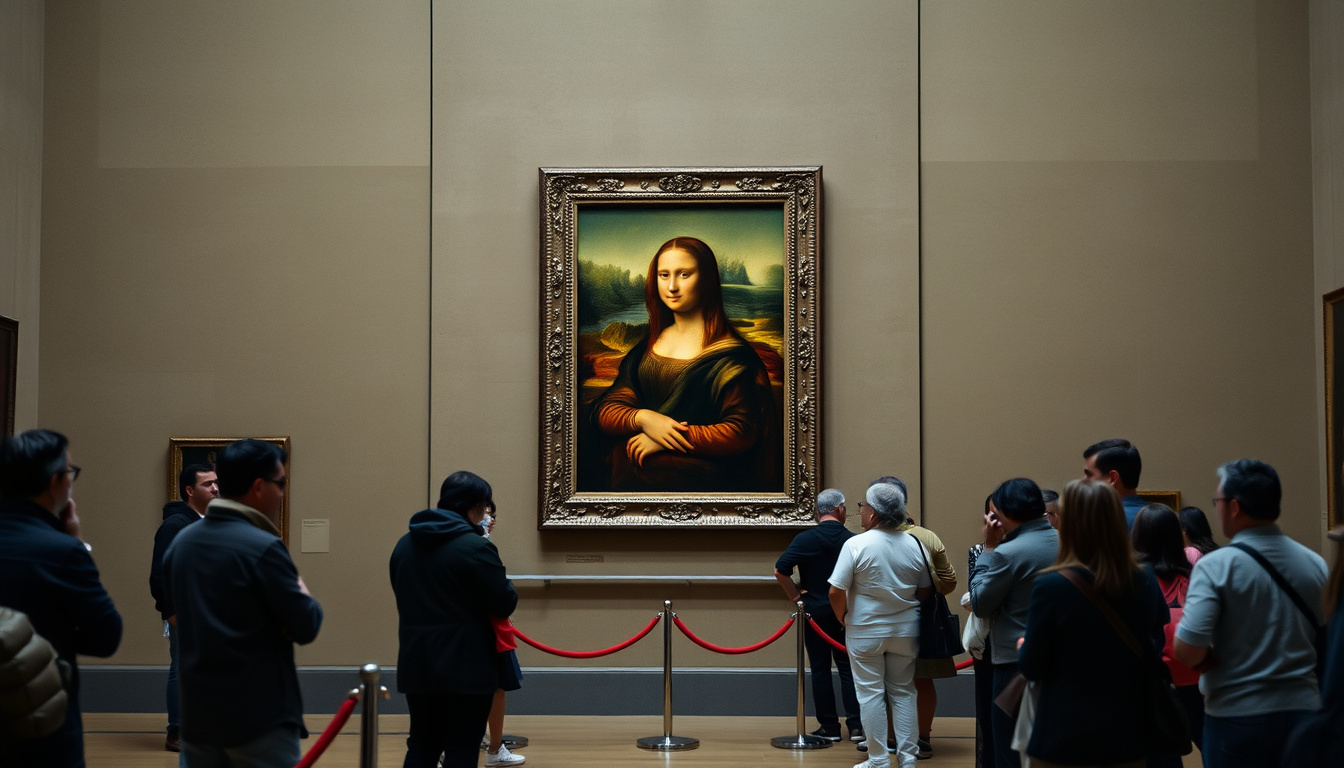
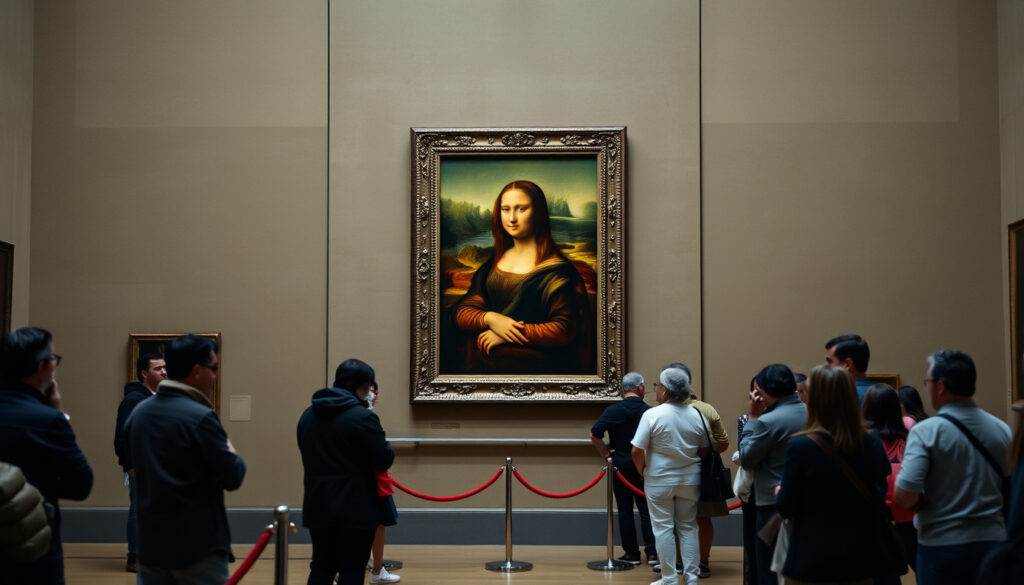
You probably know the face — that calm, half-smiling woman who seems to follow you with her eyes. There’s a reason she draws 30,000 people to the Louvre every day, and it has less to do with Renaissance technique than you might expect — this guide walks through the real story behind the world’s most famous portrait, from its quiet beginnings in Leonardo da Vinci’s studio to its bulletproof global icon status.
Year Painted: 1503–1519 (approx.) ·
Medium: Oil on poplar panel ·
Dimensions: 77 cm × 53 cm (30 in × 21 in) ·
Current Location: Louvre Museum, Paris ·
Estimated Value: Uninsurable; estimated >$870 million ·
Daily Visitors at Louvre: Approximately 30,000
Quick snapshot
- Painted by Leonardo da Vinci between 1503–1519 (Encyclopaedia Britannica)
- Sitter is Lisa Gherardini, confirmed by University of Heidelberg in 2005 (Encyclopaedia Britannica)
- Housed at the Louvre Museum since 1797 (Wikipedia)
- Stolen in 1911 by Vincenzo Peruggia, recovered in 1913 (HISTORY)
- Exact year painting started and finished (Encyclopaedia Britannica)
- Whether Leonardo intended to sell it or keep it for himself (Wikipedia)
- Precise cause of Lisa Gherardini’s death (Wikipedia)
- If the smile is intentionally ambiguous or a result of restoration (Encyclopaedia Britannica)
- 1503–1519: Leonardo paints Mona Lisa (Encyclopaedia Britannica)
- 21 August 1911: Stolen from the Louvre (Musée du Louvre)
- 1913: Recovered in Florence (BBC News)
- 2005–present: Housed in Salle des États (Musée du Louvre)
- Ongoing research into Leonardo’s materials and technique
- Continued conservation efforts in the Louvre’s climate-controlled room
- Debates over future loans — unlikely given its fragility and fame
| Specification | Detail |
|---|---|
| Full Title | Mona Lisa (La Gioconda) |
| Artist | Leonardo da Vinci |
| Year Completed | c. 1519 (unfinished) |
| Medium | Oil on poplar panel |
| Dimensions | 77 cm × 53 cm |
| Current Owner | French Republic (Louvre Museum) |
| Estimated Value | Priceless; insured for $100 million in 1962 (equivalent to >$870 million today) |
What is so special about the Mona Lisa?
The innovative sfumato technique
What sets the Mona Lisa apart technically is Leonardo’s mastery of sfumato — a painting method that creates soft, smoky transitions between colors and tones. Instead of sharp outlines, Leonardo blended layers of thin glaze so delicately that brushstrokes seem to disappear. The result: a face that appears to breathe across the canvas, with shadows and light melting into one another. The Encyclopaedia Britannica (reference work) describes sfumato as “a technique that involved applying many thin, almost transparent layers of paint to create an atmospheric effect.”
The subject’s enigmatic expression
The Mona Lisa’s smile is the painting’s great riddle. Is she amused? Sad? Flirtatious? Art historian E.H. Gombrich (art historian) famously called it “veiled and elusive” in The Story of Art. The ambiguity is partly technical — Leonardo painted the corners of the mouth and eyes with soft sfumato, leaving the viewer’s brain to fill in the emotional gap. The Musée du Louvre (official museum) notes that this very smile has “fascinated viewers for centuries.”
The painting’s role in popular culture
Before 1911, the Mona Lisa was a respected but relatively obscure Renaissance portrait. Then Vincenzo Peruggia stole it. The international manhunt transformed the painting into a household name — and modern media kept it there. The painting has appeared in songs, films, advertisements, and memes more than any other artwork. As Encyclopaedia Britannica (reference work) puts it, the Mona Lisa became “an object of pilgrimage” in the 21st century.
The pattern: what started as a private commission ended as a public phenomenon, with each layer of history adding to its mystique.
How much is the Mona Lisa painting worth?
Why the Mona Lisa is considered priceless
The Mona Lisa has never been sold, and it likely never will be — at least not in any conventional sense. It is owned by the French Republic and displayed at the Louvre. Because it is considered a national treasure, it cannot be put up for auction. Any formal price would be symbolic. In 1962, the painting was insured for $100 million while on tour — a figure that inflation-adjusted would exceed $870 million today, according to calculations by Encyclopaedia Britannica (reference work).
Comparisons to the most expensive paintings sold
A single comparison frames the gap: the most expensive painting ever sold at auction was Leonardo da Vinci’s Salvator Mundi, which fetched $450.3 million in 2017. That is roughly half the inflation-adjusted insurance figure for the Mona Lisa. Yet Salvator Mundi was privately owned and authenticated with controversy; the Mona Lisa carries the full weight of state ownership and five centuries of provenance. The table below shows how the Mona Lisa’s estimated value compares to record-breaking sales.
Five paintings, one pattern: rarity plus institutional ownership creates a pricing tier that private sales cannot reach.
| Painting | Sale Price | Year Sold | Owner Type |
|---|---|---|---|
| Mona Lisa (estimated insurable) | >$870 million (adjusted) | Uninsurable today | French state |
| Salvator Mundi | $450.3 million | 2017 | Private |
| Interchange (Jackson Pollock) | $200 million (estimated) | 2015 (private sale) | Private |
| The Card Players (Cézanne) | $250 million (estimated) | 2011 (private sale) | Private |
| Number 5, 1948 (Pollock) | $140 million | 2006 | Private |
The implication: No private buyer can match the cultural equity of a national museum. The Mona Lisa’s value is less about market forces and more about what a nation is willing to protect — which is, effectively, priceless.
Insurance and security costs
Because no insurer will underwrite a full-value policy for the Mona Lisa, the Louvre instead spends heavily on physical security. Since an acid attack in 1956 damaged the lower portion of the painting, it has been displayed behind bulletproof glass. Encyclopaedia Britannica (reference work) notes that the painting “hangs behind bulletproof glass in the Louvre.” A climate-controlled, custom-built room — the Salle des États — was installed in 2005 to maintain stable temperature and humidity.
The Louvre spends millions securing a single painting that generates enormous foot traffic — 30,000 daily visitors — but the security itself adds to the mystique. The glass becomes the stage.
What is the real story behind the Mona Lisa?
The identity of Lisa Gherardini
The woman in the portrait is widely believed to be Lisa Gherardini, the wife of Florentine silk merchant Francesco del Giocondo. For centuries, the sitter’s identity was debated. Then, in 2005, a researcher at the University of Heidelberg discovered a marginal note in a 15th-century book that explicitly named Lisa Gherardini as the subject. The Guardian (UK newspaper) notes the portrait was known as La Joconde in French — after her married name, Giocondo.
The commission from Francesco del Giocondo
Francesco del Giocondo likely commissioned the portrait around 1503 to celebrate the birth of his second son, Andrea, and the family’s new home. But Leonardo never delivered it. He kept the painting, continued reworking it for years, and eventually brought it with him when he moved to France in 1516 at the invitation of King Francis I. The Musée du Louvre (official museum) confirms that Francis I bought the painting from Leonardo in 1518.
The theft in 1911 and its aftermath
On 21 August 1911, Vincenzo Peruggia — a former Louvre employee — walked into the museum dressed in his old work uniform, removed the painting from its frame, and walked out with it hidden under his coat. The theft wasn’t discovered until the next day. According to HISTORY (historical media outlet), panic broke out at the Louvre. Peruggia kept the painting in a trunk in his apartment for over two years. He was caught in December 1913 when he tried to sell it to a Florence art dealer. BBC News (UK public broadcaster) reports the painting was recovered on 10 December 1913 and returned to the Louvre in January 1914.
What this means: The theft did more for the Mona Lisa’s fame than any exhibition ever could. Before 1911, it was a respected but minor Leonardo. After 1913, it was a global celebrity. National Geographic (science and history magazine) notes that before the theft, the Mona Lisa was a “lesser-known work” by Leonardo.
How old was Mona Lisa in real life?
Lisa Gherardini’s birth and death dates
Lisa Gherardini was born on June 15, 1479, into a noble but financially struggling Florentine family. She died on July 15, 1542, at age 63. Her lifespan of 63 years was solid for the 16th century, but the cause of death is not definitively recorded in any surviving document. According to Wikipedia (encyclopedia), historical records of her illness are sparse, and her grave in Florence has been lost.
Her age at the time of the portrait
When Leonardo began the portrait around 1503, Lisa Gherardini was about 24 years old. Her dark hair, simple attire, and direct gaze reflect a Florentine woman of the merchant class — not royalty, but not peasantry either. The portrait’s composition — three-quarter view with hands crossed — became the standard for Renaissance portraiture.
Later life and family
Lisa Gherardini outlived her husband Francesco del Giocondo, who died in 1539. She had five children: Piero, Camilla, Marietta, Andrea, and Giocondo. Two of her daughters entered convents. She spent her later years in Florence, where she died in 1542. No confirmed portrait of her from later life survives — only the Mona Lisa preserves her image.
What are 5 facts about the Mona Lisa?
Fact 1: It was never finished
Leonardo da Vinci never delivered the Mona Lisa to Francesco del Giocondo. He kept the painting, continued adding layers of glaze, and was still reworking it when he died in 1519. The unfinished sky above the landscape and the missing eyebrows — likely a result of later overcleaning — are visible clues that the painting is a work in progress.
Fact 2: The painting has its own room in the Louvre
Since 2005, the Mona Lisa has been displayed in the Salle des États, a large, climate-controlled room designed specifically for the painting. The Musée du Louvre (official museum) confirms the room was “specially designed” and that the painting has been shown there since 1966. It is the only room in the Louvre dedicated to a single artwork.
Fact 3: Napoleon once hung it in his bedroom
During the Napoleonic era, the Mona Lisa was moved from the Louvre to Napoleon Bonaparte’s private apartments in the Tuileries Palace. The emperor reportedly hung the portrait in his bedroom. It was later returned to the Louvre, but the episode underscores how the painting moved between private royal collections and public museum spaces.
Fact 4: The eyebrows are missing
If you look closely, the Mona Lisa has no visible eyebrows or eyelashes. This is likely due to overzealous cleaning or restoration attempts in earlier centuries, not Leonardo’s original intent. A 2004 infrared scan by French engineer Pascal Cotte revealed that Leonardo originally painted both eyebrows and eyelashes, but they have since been worn away or removed.
Fact 5: The painting is smaller than you think
Despite its monumental reputation, the Mona Lisa is surprisingly compact. The oil-on-poplar panel measures just 77 cm × 53 cm (30 in × 21 in) — roughly the size of a medium flat-screen monitor. Many first-time visitors are shocked by its small scale. Encyclopaedia Britannica (reference work) lists these exact dimensions.
The world’s most famous painting is small, unfinished, and missing its eyebrows — yet it draws more visitors than any artwork alive. Fame doesn’t require perfection.
Why did it take 14 years to paint the Mona Lisa?
Leonardo’s perfectionism and slow technique
Leonardo da Vinci worked on the Mona Lisa intermittently from 1503 to 1519 — nearly 16 years. He did not paint continuously; he returned to the panel over time, adding thin layers of glaze that dried slowly. Encyclopaedia Britannica (reference work) notes that he used “many thin, almost transparent layers of paint” — a technique that requires months between applications for each layer to cure.
The use of wet-on-dry oil painting
Unlike the wet-on-wet method that allows fast painting, Leonardo preferred wet-on-dry: each layer had to fully set before the next could be applied. This painstaking approach created the soft, realistic transitions that define sfumato, but it also meant the painting took years — not months — to complete.
Other commissions and travel interruptions
Leonardo was a notoriously restless artist. During the years he was working on the Mona Lisa, he also took on commissions for The Virgin of the Rocks, The Battle of Anghiari, and various engineering and anatomical studies. He traveled between Florence, Milan, and Rome, and eventually moved to France in 1516. The painting traveled with him, and he continued reworking it until his death. According to Wikipedia (encyclopedia), Leonardo may have continued working on it as late as 1517.
The pattern: Leonardo’s perfectionism, slow technique, and constant movement meant the Mona Lisa became a lifelong companion, not a commissioned project with a deadline.
How did Mona Lisa die?
Lisa Gherardini’s cause of death
The cause of Lisa Gherardini’s death is not definitively recorded in surviving historical documents. She died on July 15, 1542, at age 63. Some scholars have speculated that she may have died of an illness common in Renaissance Florence, but no specific diagnosis can be confirmed.
Historical records of her illness
What little we know comes from parish records and the memoirs of her husband’s associates. No physician’s notes or detailed deathbed accounts survive. Encyclopaedia Britannica (reference work) notes that the precise cause of death remains “unclear” — a rarity for someone who would become the most famous face in history.
Burial and legacy
Lisa Gherardini was buried in Florence, but the exact location of her grave has been lost. No headstone or marker has been identified. Attempts in the 2010s to locate her remains using ground-penetrating radar at a former convent in Florence were inconclusive. Her legacy, of course, outlives any burial site: she lives on the wall of the Louvre, seen by 30,000 people a day.
theguardian.com, sortiraparis.com, theguardian.com, pariscityvision.com, en.wikipedia.org, nationalgeographic.com, guides.loc.gov
Frequently asked questions
Who is the woman in the Mona Lisa?
The woman is widely believed to be Lisa Gherardini, the wife of Florentine silk merchant Francesco del Giocondo. A 2005 discovery by the University of Heidelberg confirmed her identity through a marginal note in a 15th-century book.
Where can I see the Mona Lisa?
The Mona Lisa is displayed at the Louvre Museum in Paris, France, in the Salle des États — a climate-controlled room dedicated to the painting. It has been on display at the Louvre since 1797.
Why is the Mona Lisa behind glass?
After an acid attack in 1956 damaged the painting’s lower portion, the Louvre installed bulletproof glass to protect it. The glass also maintains a stable climate and prevents theft.
Has the Mona Lisa ever been stolen?
Yes. On 21 August 1911, Vincenzo Peruggia, a former Louvre employee, stole the painting. It was recovered in Florence, Italy, in December 1913 and returned to the Louvre in January 1914.
What is the Mona Lisa worth?
The Mona Lisa has never been sold and is considered priceless. It was insured for $100 million in 1962 (equivalent to over $870 million today), but no modern insurer will underwrite its full value.
How big is the Mona Lisa?
The painting measures 77 cm × 53 cm (30 in × 21 in) and is painted on a poplar wood panel. It is smaller than many first-time visitors expect.
What technique did Leonardo da Vinci use for the Mona Lisa?
Leonardo used sfumato — a technique of applying many thin, transparent layers of oil paint to create soft transitions between colors and tones. The method gives the painting its smoky, atmospheric quality.
Timeline
- 1503–1506: Leonardo da Vinci begins painting the portrait of Lisa Gherardini. (Encyclopaedia Britannica)
- 1516–1519: Da Vinci brings the painting to France; continues reworking it until his death. (Musée du Louvre)
- 1519–1792: The painting stays in French royal collections at Fontainebleau and Versailles. (Wikipedia)
- 1797: Installed in the Louvre Museum. (Wikipedia)
- 21 August 1911: Stolen from the Louvre by Vincenzo Peruggia. (HISTORY)
- December 1913: Recovered in Florence, Italy; returned to the Louvre. (BBC News)
- 1956: Damaged by an acid attack; protected by bulletproof glass thereafter. (Encyclopaedia Britannica)
- 1974: Exhibited in Tokyo and Moscow; bulletproof case added. (Encyclopaedia Britannica)
- 2005–present: Housed in a specially designed, climate-controlled room (Salle des États). (Musée du Louvre)
Clarity section
Confirmed facts
- Leonardo da Vinci painted the Mona Lisa. (Encyclopaedia Britannica)
- The sitter is Lisa Gherardini (confirmed by University of Heidelberg in 2005). (Encyclopaedia Britannica)
- The painting is housed at the Louvre Museum. (Wikipedia)
- It was stolen in 1911 and recovered in 1913. (HISTORY)
What’s unclear
- Exact year painting started and finished. (Encyclopaedia Britannica)
- Whether Leonardo intended to sell it or keep it. (Wikipedia)
- Precise cause of Lisa Gherardini’s death. (Wikipedia)
- If the smile is intentionally ambiguous or a result of restoration.
Expert perspectives
“The Mona Lisa’s smile is veiled and elusive.”
— E.H. Gombrich, art historian, in The Story of Art
“The smile has fascinated viewers for centuries.”
— Musée du Louvre, official description
“Before the 1911 theft, the Mona Lisa was a lesser-known work by Leonardo da Vinci.”
— National Geographic, historical analysis
The Mona Lisa is not just a Renaissance portrait — it is proof that fame and skill are not the same thing, and that a single theft can rewrite cultural history. For the everyday visitor, the lesson is: what you see behind the glass is a small, unfinished painting that became the world’s most valuable artifact because of what happened to it, not just how it was made. For art historians, the painting remains a technical marvel. The Mona Lisa’s fame reminds us that cultural artifacts can transcend their original purpose through circumstance and history.
Related stories





Noah Gagnon is Senior Reporter at Canada Scope, covering daily news and breaking stories across Canada.