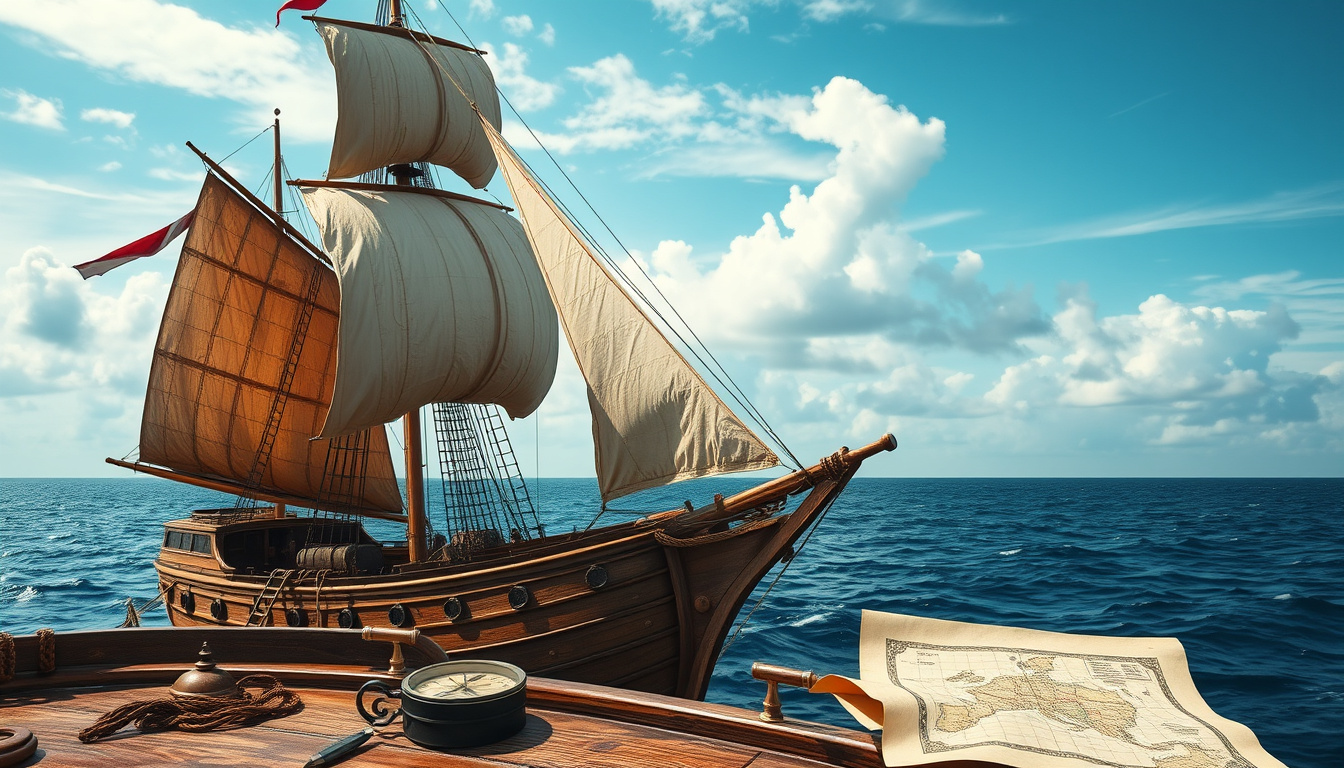
Few names in history spark as much debate as Christopher Columbus. Hero to some, villain to others, the Genoese explorer sits at the center of a centuries-old story that mixes fact, fiction, and fierce disagreement. This article sets the record straight on what we know, what we don’t, and who else reached the Americas before he did.
Born: c. 1451, Genoa, Italy ·
Died: May 20, 1506, Valladolid, Spain ·
Voyages: 4 transatlantic voyages (1492, 1493, 1498, 1502) ·
First landfall: October 12, 1492, in the Bahamas
Quick snapshot
- Born in Genoa c. 1451 (Encyclopaedia Britannica (definitive reference))
- Four transatlantic voyages between 1492 and 1504 (Encyclopaedia Britannica (summary))
- Died in Valladolid, Spain, May 20, 1506 (Encyclopaedia Britannica)
- Exact birth date (sources give August–October 1451) (Encyclopaedia Britannica)
- His last words are unconfirmed (Biography.com (biographical authority))
- Whether he had blue eyes is disputed (Encyclopaedia Britannica)
- First voyage departed August 3, 1492 from Palos (BBC History (UK public service broadcaster))
- Landfall in the Bahamas on October 12, 1492 (HISTORY (US editorial network))
- First European settlement La Isabela founded 1494 (Encyclopaedia Britannica)
- Columbus’s voyages triggered the Columbian Exchange (Wikipedia (crowdsourced encyclopedia))
- Debate over his legacy continues in education and public monuments (Wikipedia (crowdsourced encyclopedia))
- Pre-Columbian contact theories gain more scholarly attention (Encyclopaedia Britannica)
| Attribute | Value |
|---|---|
| Full Name | Cristoforo Colombo (Italian), Cristóbal Colón (Spanish) |
| Born | c. 1451, Genoa, Republic of Genoa |
| Died | May 20, 1506, Valladolid, Castile |
| Nationality | Italian (Genoese) |
| Occupations | Explorer, navigator |
| Known for | Transatlantic voyages leading to European awareness of the Americas |
| First voyage | 1492, with ships Niña, Pinta, Santa María |
| Spouse | Filipa Moniz Perestrelo |
What is Christopher Columbus famous for?
The four voyages
- Columbus is best known for his 1492 voyage, which departed Palos on August 3, 1492 with three ships — the Santa María, Niña, and Pinta (BBC History).
- He completed four transatlantic voyages in total: 1492–93, 1493–96, 1498–1500, and 1502–04 (Encyclopaedia Britannica).
- On the second voyage he founded La Isabela in the Dominican Republic, the first European settlement in the New World (Encyclopaedia Britannica (summary)).
Legacy and controversy
His voyages initiated a period of European colonization that transformed the globe. But the cost for indigenous peoples was catastrophic: enslavement, disease, and displacement. Modern historians debate whether to honor him as a discoverer or condemn him as an invader.
“The Columbus voyages are commonly linked to the Columbian Exchange, the transfer of people, plants, animals, and diseases across the Atlantic.”
The pattern: Columbus’s legacy is a mirror — one side reflecting European ambition, the other reflecting indigenous trauma. The debate is unlikely to settle soon.
Who actually first discovered America?
Indigenous peoples
The first humans to reach the Americas arrived across the Bering land bridge more than 15,000 years ago. These ancestors of today’s Native Americans were the true discoverers of the continent.
Viking settlements
Norse explorers from Greenland led by Leif Erikson established a settlement at L’Anse aux Meadows in Newfoundland around 1000 AD (Encyclopaedia Britannica). This is the first confirmed European contact with the Americas, predating Columbus by nearly 500 years.
Pre-Columbian contact theories
Other proposed pre-Columbian contacts — from Polynesian, Chinese, or African voyages — remain poorly evidenced. The Viking presence is the only widely accepted pre-Columbian European landing.
Recognizing pre-Columbian explorers doesn’t diminish Columbus’s role in opening sustained transatlantic exchange. It corrects a Eurocentric narrative that erased earlier journeys.
Four major groups, one key pattern: none of the earlier contacts led to permanent colonization — Columbus’s voyages did. The table below compares the evidence.
| Group | Date | Evidence | Significance |
|---|---|---|---|
| Indigenous peoples | >15,000 years ago | Archaeological sites, genetic data | First human inhabitants |
| Norse (Vikings) | ~1000 AD | L’Anse aux Meadows settlement | First European contact |
| Christopher Columbus | 1492 | Ship logs, multiple voyages, colonization | Permanent European presence |
The trade-off: The Vikings reached the Americas first, but Columbus’s voyages changed the world permanently. The difference is not timing but consequence.
What are 5 facts about Christopher Columbus?
Fact 1: He wasn’t the first
Indigenous peoples had lived in the Americas for millennia, and Vikings reached North America around 1000 AD (Encyclopaedia Britannica).
Fact 2: He never set foot in mainland North America
Columbus explored the Caribbean, northern South America, and Central America — but never the modern US or Canada.
Fact 3: He made four voyages
Dates: 1492–93, 1493–96, 1498–1500, 1502–04. His last voyage ended in shipwreck in Jamaica.
Fact 4: He died believing he had reached Asia
Even after four voyages, Columbus clung to the belief that Cuba was part of Asia (Biography.com).
Fact 5: His voyages led to the Columbian Exchange
The exchange of crops, animals, diseases, and people across the Atlantic reshaped the world (Wikipedia).
What were Columbus’s last words?
Reported phrase
The most commonly cited last words are “In manus tuas, Domine, commendo spiritum meum” (“Into your hands, Lord, I commend my spirit”). The phrase appears in later biographies but lacks contemporary documentation (Biography.com).
Historical reliability
No eyewitness account of Columbus’s final moments survives. The earliest source for the Latin phrase is from the 17th century, more than 100 years after his death. Scholars consider it apocryphal.
“Columbus died in Valladolid, Spain, on May 20, 1506.”
Encyclopaedia Britannica (authoritative reference)
The catch: The famous last words are likely a pious invention. What we know for certain is the date and place of death.
Who came first, Vikings or Columbus?
Viking settlement at L’Anse aux Meadows
Archaeological excavations at L’Anse aux Meadows in Newfoundland date to around 1000 AD (Encyclopaedia Britannica). The site includes eight buildings and evidence of ironworking.
Leif Erikson’s voyage
According to the sagas, Leif Erikson sailed from Greenland to a land he called Vinland around 1000 AD. The archaeological site matches the saga descriptions closely.
Columbus’s 1492 voyage
Columbus left Palos on August 3, 1492 and made landfall in the Bahamas on October 12, 1492 — nearly 500 years after the Vikings (HISTORY).
The Vikings definitively came first. But their settlements were temporary and did not lead to sustained transatlantic contact. Columbus’s voyages, for better or worse, changed the course of history.
Did Columbus have blue eyes?
Historical descriptions
Contemporary accounts describe Columbus as having light-colored eyes, but the specific color is not recorded. The claim of blue eyes appears in later romanticized portraits.
Lack of contemporary portraits
No portrait of Columbus painted during his lifetime survives. All existing images are posthumous, often idealized.
Modern reconstructions
Forensic facial reconstruction from a presumed skull has been attempted, but reliable physical evidence is lacking. The blue-eye myth remains a curiosity with no factual basis.
“The exact island of first landfall remains debated.”
Timeline of Christopher Columbus
| Date | Event |
|---|---|
| c. 1451 | Born in Genoa |
| 1470s | Early maritime career |
| 1485 | Presented his plan to Spanish monarchs |
| 1492 | First voyage, landfall in the Bahamas |
| 1493 | Second voyage, colonization of Hispaniola |
| 1498 | Third voyage, reached South America |
| 1502 | Fourth voyage, explored Central America |
| 1506 | Died in Valladolid |
What this means: Columbus’s timeline spans 15 years of active exploration — an extraordinary feat of seamanship that nevertheless sits in the shadow of much earlier human arrivals.
Confirmed facts
- Birth year of 1451 (approximate) (Encyclopaedia Britannica)
- Four voyages (Encyclopaedia Britannica)
- Death in 1506 (Encyclopaedia Britannica)
What’s unclear
- Exact birth date
- Last words
- Blue eyes
- Appearance overall
- Number of crew on first voyage
The confidence in many details of Columbus’s life is surprisingly low given his fame. Readers should approach popular claims — especially last words and physical appearance — with healthy skepticism.
en.wikipedia.org, christopher-columbus.eu, thecollector.com, en.wikipedia.org, enchantedlearning.com, welcomehomevetsofnj.org
Frequently asked questions
How many ships were in Columbus’s first fleet?
Three ships: the Santa María (the flagship), the Niña, and the Pinta.
What was the Columbian Exchange?
The widespread transfer of plants, animals, culture, human populations, technology, diseases, and ideas between the Americas and the Old World following Columbus’s voyages.
Did Columbus ever reach mainland North America?
No. He explored the Caribbean, northern South America, and Central America, but never set foot on the present-day United States or Canada.
Why is Columbus Day controversial?
Many indigenous groups and historians object to celebrating a figure associated with colonization, enslavement, and violence. Alternative observances like Indigenous Peoples’ Day have grown.
What was Columbus’s original name?
In Italian, Cristoforo Colombo; in Spanish, Cristóbal Colón. He was born in Genoa and later adopted the Spanish version.
Who sponsored Columbus’s voyages?
King Ferdinand and Queen Isabella of Spain, after other European courts rejected his proposal.
Where did Columbus land in 1492?
On an island in the Bahamas, likely present-day San Salvador or a neighboring island. The exact location is debated.

Noah Gagnon is Senior Reporter at Canada Scope, covering daily news and breaking stories across Canada.