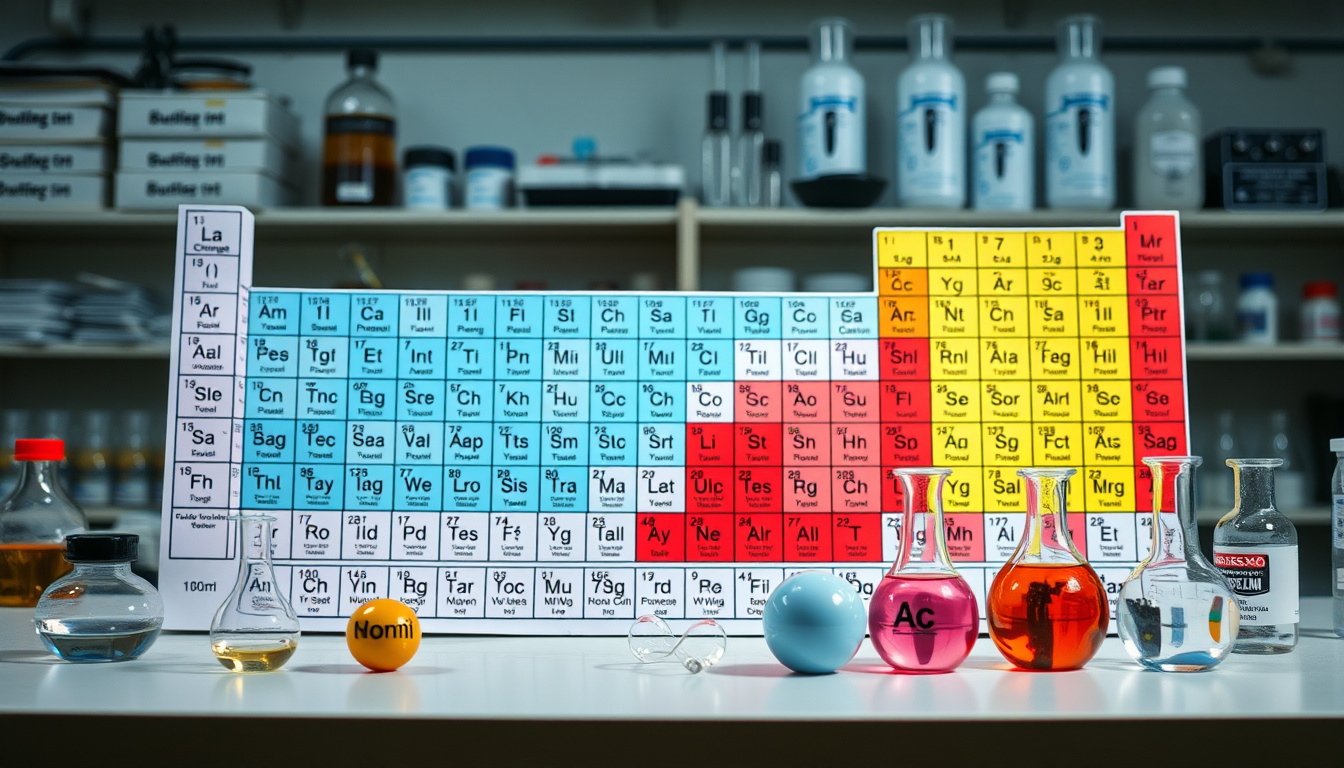
Charge annotations transform the standard periodic table into a practical chemistry tool—one that predicts how elements will bond, balance equations, and make sense of ionic compounds. This guide covers all 118 elements with their common charges, printable resources, polyatomic ion lists, and the group patterns that make charge prediction manageable rather than memorized.
Total Elements: 118 · Alkali Metals Charge: +1 · Alkaline Earth Metals Charge: +2 · Halogens Charge: −1 · Oxygen Group Charge: −2
Quick snapshot
- 118 elements with ionic charges listed (Science Notes)
- Polyatomic ions include NH4+ and PO43− (Breslyn.org)
- PDF fits on a single 8.5 × 11 inch sheet (Science Notes)
- Exact publication dates for most PDFs
- Regional variations beyond US and Canada
- Which specific transition metals prefer which charges in specific compounds
- Polyatomic ion naming guides uploaded 2017 (Ms Milbradt Blog)
- Government periodic tables have no stamped revision dates (Ms Milbradt Blog)
- Community-created tables continue updating annually (Science Notes)
- Double-sided printables combining charges and naming rules (Teachers Pay Teachers)
- Editable PowerPoint versions for classroom customization (Passionately Curious Sci)
- Interactive digital tables with charge-filtering features (Teachers Pay Teachers)
| Label | Value |
|---|---|
| Elements Covered | 118 |
| Most Common Charge | +1 (Group 1) |
| Polyatomic Examples | NH4+, PO43− |
| Nitrate ion formula | NO3− |
| Sulfate ion formula | SO42− |
| Carbonate ion formula | CO32− |
| Iron common ions | Fe2+, Fe3+ |
| Copper common ions | Cu+, Cu2+ |
| Hydrogen ion charge | H+ |
| Sodium ion charge | Na+ |
Periodic table with charges pdf
A printable periodic table with charges condenses essential ionic data onto a single page, making it practical for lab benches, study sessions, and classroom walls. These PDFs typically include the atomic number, element symbol, name, atomic mass, electron shell configuration, and the most common oxidation states for each of the 118 elements.
Download options
Free downloadable PDFs come from multiple sources. Science Notes offers a full-color version optimized to fit on a standard 8.5 × 11 inch sheet while maintaining legibility for element symbols and charge notations. Government education sites like Gov NL Education (Newfoundland K–12 curriculum) and VSB BC Chemistry Data Page (British Columbia schools) provide official versions that also list electronegativity values and molar masses alongside ionic charges.
PDF features
The most useful printable versions group elements by charge rather than position alone. This layout lets students scan horizontally to see how charges change across a period or vertically to confirm that Group 1 elements (lithium through francium) consistently carry +1. Western Oregon University Chemistry provides a version showing ion charges like H+ for hydrogen, Li+ for lithium, and Na+ for sodium directly beneath each element symbol.
Periodic table with charges and polyatomic ions
Monatomic ions—single atoms with a charge—are predictable from group position alone. Polyatomic ions are different: these clusters of atoms behave as single units and carry charges that cannot be derived from the periodic table without memorization. A table that includes both monatomic and polyatomic ion data gives students a complete reference for writing formulas and naming compounds.
Common polyatomic ions
The most frequently encountered polyatomic ions appear across virtually every high school and introductory college chemistry course. Breslyn.org lists six ions that appear on nearly every reference chart: ammonium NH4+, hydroxide OH−, nitrate NO3−, carbonate CO32−, sulfate SO42−, and phosphate PO43−. Of these, ammonium NH4+ is the only common positive polyatomic ion worth singling out for focused memorization, according to Chui Science.
The “-ATE” ions form a useful subset: nitrate NO3−, phosphate PO43−, sulfate SO42−, and carbonate CO32− each contain a central atom bonded to multiple oxygen atoms. Their “-ITE” counterparts (nitrite NO2−, phosphite PO33−, sulfite SO32−) have one fewer oxygen atom but carry the same charge. This pattern, documented by Ms Milbradt Blog, means that once students master the four common “-ATE” ions, the “-ITE” variations follow logically.
Integration with element table
Double-sided periodic tables solve the space problem by placing ionic charges and atomic masses on the front and polyatomic ions with naming rules on the back. Teachers Pay Teachers offers free versions of these double-sided printables, and Passionately Curious Sci provides an editable PowerPoint version that teachers can customize for their specific curriculum.
Polyatomic ions must be memorized—they cannot be derived from periodic table position alone. Students who invest time memorizing the six core ions first will find formula writing far easier than those who attempt to look up every ion during exercises.
Periodic table with charges and symbols
Element symbols on a charge-annotated table do double duty: they identify the element while the superscript charge notation tells you how that element will behave in ionic bonding. Understanding the symbol-charge relationship is the foundation for predicting compound formulas.
Symbol-charge mapping
The mapping from symbol to charge follows predictable patterns for main-group elements. Western Oregon University Chemistry displays this directly: H+ shows hydrogen as a +1 cation, Na+ shows sodium as a +1 cation, and Cl− shows chlorine as a −1 anion. The plus sign always indicates a cation (positive charge, electron loss), while the minus sign indicates an anion (negative charge, electron gain).
Examples by group
Group 1 metals form +1 ions: Li+, Na+, K+, Rb+, Cs+. Group 2 metals form +2 ions: Be2+, Mg2+, Ca2+, Sr2+, Ba2+. Group 17 halogens form −1 ions: F−, Cl−, Br−, I−. Group 16 non-metals form −2 ions: O2−, S2−, Se2−, Te2−. Chui Science adds that Group 15 non-metals gain three electrons to form 3− ions: N3−, P3−, As3−.
For main-group elements, the charge is directly predictable from the group number: Group 1 = +1, Group 2 = +2, Group 13 = +3, Group 15 = −3, Group 16 = −2, Group 17 = −1, Group 18 = 0.
Periodic table with charges and groups
Group position on the periodic table determines ionic charge for the main-group elements, but the transition metals in the center block require individual attention. Understanding this distinction is essential for anyone working with ionic compound nomenclature.
Group 1 charges
The alkali metals in Group 1 reliably form +1 ions because they have one electron in their outermost shell that they readily lose. This predictable behavior makes Group 1 charges the first lesson in ionic bonding. Chui Science confirms that Group 1 metals form 1+ ions that are entirely predictable from their position on the periodic table.
Transition metal variability
Transition metals in Groups 3 through 12 break the simple group-to-charge rule. Ms Milbradt Blog documents that eight transition metals commonly exhibit multiple charges in different compounds: cobalt (Co), chromium (Cr), copper (Cu), iron (Fe), manganese (Mn), mercury (Hg), tin (Sn), and lead (Pb). Iron, for example, forms Fe2+ (iron(II)) and Fe3+ (iron(III)), while copper forms Cu+
Related stories





Hannah Walsh covers federal and provincial politics and public policy for Canada Scope.