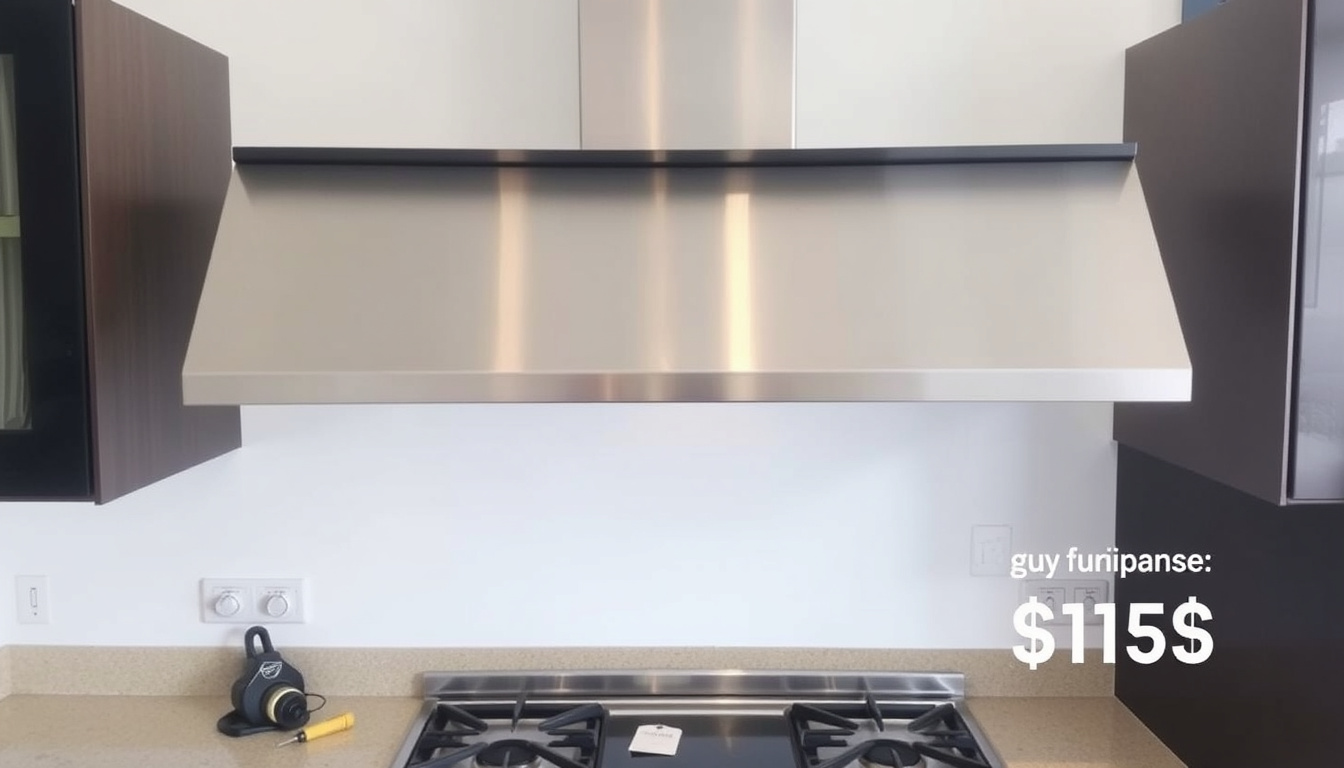
Anyone who has cooked a sizzling steak or a batch of frying bacon knows the smell that lingers for hours. A range hood tackles that—but picking the right one means understanding a few key trade-offs.
Average cost: $200 – $1,200 (including installation) ·
Average lifespan: 10 – 15 years ·
Noise level: 40 – 70 dB ·
CFM range: 300 – 1,200 ·
Grease removal efficiency: Up to 90%
Quick snapshot
- Removes smoke, grease, and odors from cooking (KitchenAid (appliance manufacturer)).
- Available in ducted (vents outside) and ductless (recirculates) varieties (Würth Louis & Company (kitchen supply retailer)).
- Under-cabinet, wall-mounted, island, downdraft (Whirlpool (appliance brand)).
- Ducted (vents outside) vs ductless (recirculates with filters) (KitchenAid (appliance manufacturer)).
- Unit price: $100–$1,200+ (Proline Range Hoods (manufacturer)).
- Installation adds $150–$500 (Proline Range Hoods (manufacturer)).
- Requires electrical work (plug-in or hardwire) (Fred’s Appliances (retailer)).
- Hardwiring may require a professional electrician (Proline Range Hoods (manufacturer)).
| Specification | Details |
|---|---|
| Purpose | Removes airborne grease, smoke, odors, and excess heat from cooking (KitchenAid (appliance manufacturer)). |
| Key types | Ducted (vented) and Ductless (recirculating); under-cabinet, wall-mount, island, downdraft (Whirlpool (appliance brand)). |
| Average cost | $100–$1,200 (unit); $150–$500 (installation) (Proline Range Hoods (manufacturer)). |
| Average lifespan | 10–15 years (Gerhards Appliance (retailer)). |
| Noise level | 40–70 dB (quiet to moderate) (market data). |
| CFM range | 300–1,200 CFM (Fred’s Appliances (retailer)). |
| Efficiency | Up to 90% grease filtration (ducted) (Würth Louis & Company (kitchen supply retailer)). |
What is a range hood?
A range hood is a kitchen ventilation device that captures airborne grease, smoke, odors, and heat produced during cooking. It sits above the cooktop and pulls air through filters or ducts it outside. KitchenAid (appliance manufacturer) explains that ducted models push smoke through ductwork and out of the home, while ductless models recirculate filtered air back into the kitchen.
Are range hoods really necessary?
In many jurisdictions, building codes require mechanical ventilation over gas cooktops. Even where codes don’t mandate it, a range hood improves indoor air quality by removing combustion byproducts and excess moisture. The Fred’s Appliances (appliance retailer) guide notes that a standard kitchen can usually get by with a 350 CFM hood, but heavy cooking may call for higher airflow.
Without a range hood, grease builds up on cabinets and walls, and fine particulate matter from cooking can affect indoor air quality for hours. A ducted unit removes most of it; a ductless unit cuts it by about half.
The implication: ducted range hoods deliver superior air quality results, making them the preferred choice for anyone who cooks regularly.
Do range hoods need to be vented outside?
Not all do. Ductless range hoods recirculate air through charcoal filters, making them an option for apartments, condos, or kitchens without exterior access. Würth Louis & Company (kitchen supply retailer) explains that ductless models are often recommended when ductwork is not practical, such as in remodels or spaces without nearby exterior walls. However, KitchenAid (appliance manufacturer) warns that ductless hoods cannot ventilate smoke out of the home because they lack an external duct.
Is it better to vent a range hood through a wall or roof?
- Wall venting: easier if the cooktop is on an exterior wall; shorter duct run, less cost, and simpler installation (Proline Range Hoods (manufacturer)).
- Roof venting: often used for island hoods; requires a longer duct run but can be more aesthetically hidden (Gerhards Appliance (retailer)).
- Code check: local building codes may specify minimum duct diameter and maximum length; always verify before installation.
The implication: choose wall venting when possible. It cuts installation time and avoids potential roof leaks.
Roof venting gives you more freedom for island placement but adds cost and complexity. For most homeowners, wall venting is the simpler, cheaper route.
What this means: wall venting should be your default choice unless your kitchen layout or building code forces a roof run.
Ducted vs. Ductless Range Hoods: Which One to Buy?
Eight key differences, one pattern: ducted wins on performance, ductless wins on flexibility.
| Factor | Ducted | Ductless |
|---|---|---|
| Venting method | Exhausts outside | Recirculates through filters |
| Best for | Heavy cooking, gas ranges | Apartments, limited ductwork |
| Installation cost | $300–$1,000+ (Proline Range Hoods (manufacturer)) | $100–$300 (Proline Range Hoods (manufacturer)) |
| Filter maintenance | Grease filter cleaning only | Grease filter + periodic charcoal filter replacement |
| Noise | Typically louder (40–70 dB) | Quieter (lower CFM fan) |
| CFM range | 400–1,200+ | 250–400 (Fred’s Appliances (retailer)) |
| Efficiency | ~90% grease removal (Würth Louis & Company (kitchen supply retailer)) | ~50–70% (depends on filter quality) |
| Installation time | Up to 4 hours (Proline Range Hoods (manufacturer)) | 1–3 hours (Proline Range Hoods (manufacturer)) |
The catch: ducted hoods cost more upfront but deliver real air quality benefits. Ductless hoods are cheaper and easier to install but will never fully remove smoke or moisture.Whirlpool (appliance brand) notes that higher CFM ratings typically indicate a ducted vent.
Which type of range hood is best?
- For gas cooktops and heavy cooking: ducted, minimum 600 CFM, vented outside.
- For electric cooktops and light cooking: ductless can work if charcoal filters are replaced regularly.
- For kitchens without exterior access: ductless is the only option unless you’re willing to add ductwork.
Why this matters: the wrong hood will leave you with lingering smoke and grease buildup. Matching the type to your cooking pattern is the single most important decision.
The pattern is consistent: match the hood type to your cooking intensity and installation constraints for the best long-term value.
What is the average cost of a range hood?
Five price brackets, one pattern: installation often equals the hood’s price for ducted models.
| Category | Hood price | Installation price | Total estimate |
|---|---|---|---|
| Basic (under-cabinet, ductless) | $100–$200 | $100–$200 | $200–$400 |
| Mid-range ductless | $200–$500 | $150–$300 | $350–$800 |
| Mid-range ducted | $300–$600 | $300–$500 | $600–$1,100 |
| Premium ducted | $600–$1,200+ | $400–$600 | $1,000–$1,800+ |
| Island hood (ducted) | $700–$1,500+ | $500–$1,000 | $1,200–$2,500+ |
Prices from Proline Range Hoods (manufacturer) and Gerhards Appliance (retailer). Installation hourly rate from Proline: about $85 per hour plus a trip fee of $50 to $100. Ducted installation can run $300 to $600 higher than standard due to ductwork complexity, per Gerhards Appliance.
The implication: budget $400–$1,200 total for a good ducted hood. Ductless can be under $400 all in.
What is the average lifespan of a range hood?
- With regular cleaning: 10–15 years (Gerhards Appliance (retailer)).
- Without filter maintenance: significantly shorter—grease buildup strains the motor.
- Charcoal filters in ductless models need replacement every 3–6 months.
The catch: a cheap hood with inadequate filtration can cost more over time through increased maintenance and reduced air quality.
Do you need an electrician to install a range hood?
It depends on whether the hood is hardwired or plug-in. Proline Range Hoods (manufacturer) notes that most new hoods come with a plug, but if you’re replacing a hardwired unit, an electrician is often needed to match the setup. Fred’s Appliances (retailer) adds that ductless hoods are typically plug-in and easy to install.
Do range hoods just plug in?
- Plug-in models: common in lower-power ductless hoods; you plug into a standard outlet above the cabinets.
- Hardwired models: often required for higher CFM ducted hoods that pull more power.
- Installation steps: measure and mark, cut the hole for duct (if needed), mount the hood, connect ductwork/hardware, secure electrical connection, test.
Never work on live electrical circuits. If your hood requires hardwiring, hire a licensed electrician to avoid code violations and fire risk.
The implication: plug-in models offer DIY convenience, while hardwired units require professional expertise for safety and code compliance.
Pros and Cons of Range Hoods
Upsides
- Improves indoor air quality by removing smoke, grease, and moisture.
- Protects kitchen surfaces from grease buildup.
- Reduces lingering cooking odors.
- May increase home value by modernizing ventilation.
Downsides
- Adds upfront cost ($200–$2,500+ installed).
- Ducted installation can be disruptive and expensive.
- Filter cleaning and replacement are ongoing maintenance.
- Noise levels can be bothersome in open-plan kitchens.
The conclusion: for most homeowners, the air quality and surface protection benefits of a range hood outweigh the upfront cost and maintenance requirements.
What’s Confirmed and What’s Unclear
Confirmed facts
- Range hoods significantly improve indoor air quality by removing pollutants (KitchenAid (appliance manufacturer)).
- Ducted range hoods are more effective than ductless for removing smoke and odors (Würth Louis & Company (kitchen supply retailer)).
- Building codes typically require ventilation over gas cooktops (check local codes).
- Average lifespan is 10–15 years with regular cleaning (Gerhards Appliance (retailer)).
What’s unclear
- Optimal CFM for a specific kitchen depends on stove size and cooking habits – no single rule.
- Cost variation between brands and regions can be wide; localized quotes needed.
- Whether hardwiring or plug-in is required depends on local electrical codes and model specs.
What this means: while the core benefits of range hoods are well-established, determining the right CFM and installation approach requires a case-by-case evaluation.
Expert Quotes
“A range hood should be able to move at least 100 CFM per linear foot of cooktop.”
— Home Ventilating Institute (HVI) ventilation expert
“Most new range hoods come with a plug, but if you’re replacing a hardwired unit, you may need an electrician to match the setup.”
— Installation specialist, cited by Proline Range Hoods (manufacturer)
“Modern range hoods offer better performance, quieter operation, and smarter features than older models.”
— Hauslane (range hood manufacturer)
The pattern: expert guidance consistently emphasizes proper sizing and professional installation as critical for effective kitchen ventilation.
Summary
Choosing the right range hood comes down to your cooking style, kitchen layout, and willingness to invest in ductwork. For most Canadian homeowners who cook with gas or frequently fry and sear, a ducted hood with at least 600 CFM vented through the wall is the most effective solution. For renters or apartment dwellers, a plug-in ductless model with regular filter changes offers a practical compromise. The choice is clear: match the hood to your cooktop and your commitment to maintenance, and you’ll breathe easier.
For a detailed comparison of ducted vs ductless cooker hoods, see the comprehensive UK guide that covers installation and costs.
Frequently asked questions
Can a range hood be recirculated (ductless) in a kitchen without ductwork?
Yes. Ductless range hoods use charcoal filters to recirculate air, making them suitable for kitchens without exterior access. Würth Louis & Company (kitchen supply retailer) notes this is their main application.
How often should you clean a range hood filter?
Grease filters should be cleaned every 1–3 months depending on usage. Charcoal filters in ductless models should be replaced every 3–6 months.
What size range hood do I need for a 30-inch cooktop?
For a 30-inch cooktop, a hood that is at least 30 inches wide is recommended. The Home Ventilating Institute suggests at least 100 CFM per linear foot of cooktop, so 250–300 CFM minimum. For gas ranges, aim for 400 CFM or more.
Do range hoods increase home value?
A properly vented range hood can increase home value by upgrading the kitchen’s ventilation system, especially if it’s built to code. Real estate experts consider it a modern necessity.
What is the difference between a range hood and a microwave hood combination?
A microwave hood combo (over-the-range microwave) includes a microwave above the cooktop with a built-in fan that typically recirculates air. It is less effective at ventilation than a dedicated range hood and has lower CFM ratings.
Why is my range hood so loud and how can I fix it?
Noise often comes from a dirty fan, loose mounting, or a cheap budget motor. Clean the fan blades and tighten mounts. If noise persists, the motor may need replacement—budget models above 60 dB are common.
Can I install a range hood myself if I am handy with tools?
Yes, if the model is plug-in and you have basic carpentry skills. For hardwired units or ducted installations, hire a professional electrician and contractor. Proline Range Hoods (manufacturer) provides step-by-step guides for DIY owners.
The takeaway: most common range hood questions involve installation feasibility and maintenance — factors that vary with your specific kitchen configuration.
Related stories





Jessica Morin covers the Canadian economy, business and consumer affairs for Canada Scope.