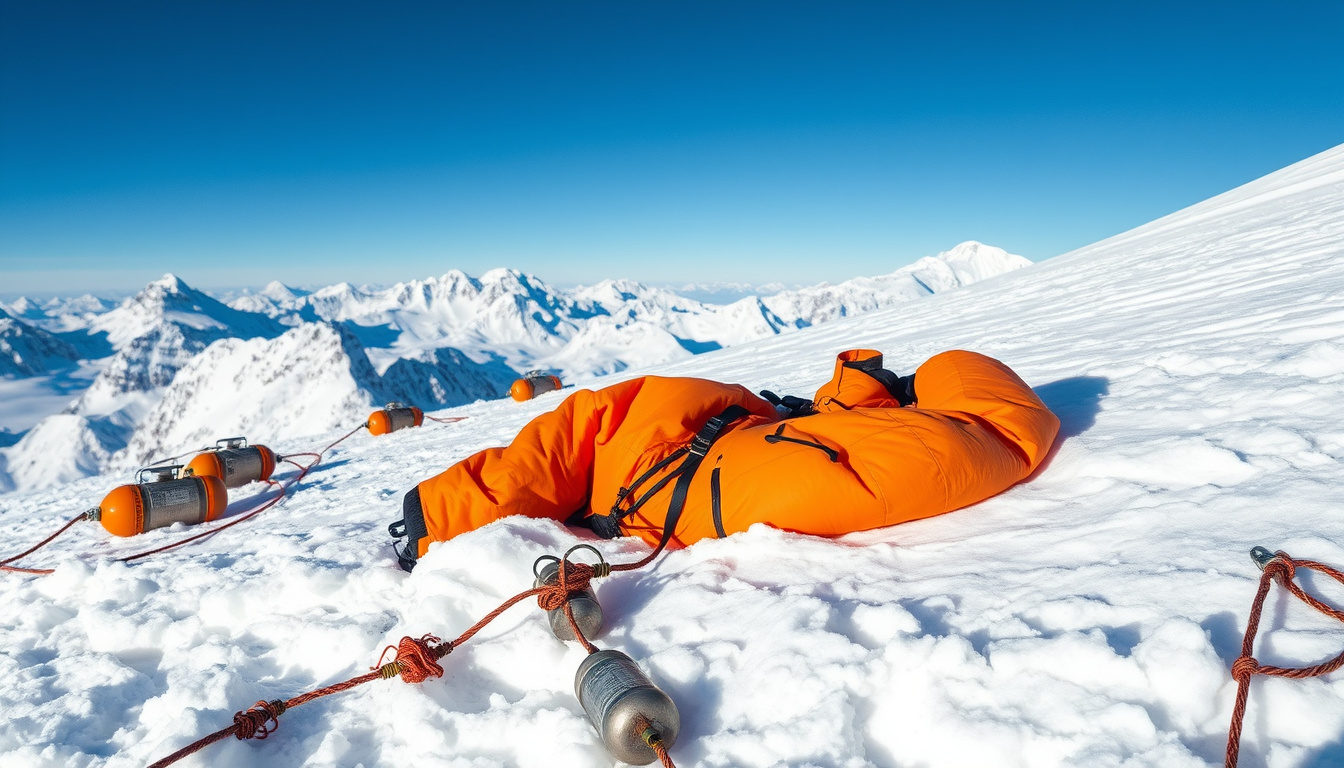
There’s something unsettling about a mountain that doubles as a graveyard—and Mount Everest, for all its majesty, holds an estimated 200 bodies on its slopes. These frozen remains aren’t just tragic statistics; they’re grim landmarks, historical artifacts, and in some cases, decades-old mysteries.
Total deaths on Mount Everest: 346+ ·
Bodies remaining on the mountain: ~200 ·
Oldest known body: George Mallory (1924) ·
Most famous body: Green Boots (Tsewang Paljor) ·
Recent discovery (2024): Andrew Irvine’s remains ·
Year of first known death: 1922
Quick snapshot
- Whether Irvine’s remains are conclusively identified (National Geographic)
- Exact number of bodies due to snow coverage (Smithsonian Magazine)
- Whether Mallory and Irvine reached the summit (Wikipedia)
- 1924: Mallory and Irvine disappear (Trek EBC)
- 1999: Mallory’s body discovered (Wikipedia)
- 2024: Irvine’s remains reported found (National Geographic)
- Formal identification of Irvine remains pending (National Geographic)
- Melting ice will expose more bodies (Phys.org)
- Recovery operations continue at high cost (BBC News)
The following table compiles the key facts about Everest’s dead.
| Fact | Value |
|---|---|
| Total deaths | 346 (as of 2023 per Wikipedia) |
| Bodies remaining | Approximately 200 (Smithsonian Magazine) |
| Oldest body | George Mallory (died 1924) (Wikipedia) |
| Most recent discovery | Andrew Irvine remains (October 2024) (National Geographic) |
| Highest body | Unknown – many above Camp IV (Outside) |
| Most photographed | Green Boots (Wikipedia) |
What happened to Andrew Irvine’s remains?
The 2024 discovery of human remains on the Northeast Ridge of Mount Everest has reignited one of mountaineering’s most enduring mysteries—whether Andrew Irvine and George Mallory reached the summit in 1924, 29 years before Hillary and Tenzing. The story of Irvine’s remains weaves together a century-old expedition, a lost camera, and a find that could rewrite history.
The 1924 Mallory and Irvine expedition
On June 8, 1924, George Mallory and Andrew Irvine set out from their high camp on the North Col toward the summit of Mount Everest. They were last seen alive by teammate Noel Odell, who reported spotting them “going strong for the top” at around 12:50 p.m. before clouds obscured their figures (Trek EBC). Neither man returned. The 1924 British expedition, which reached Everest before the first confirmed summit ascent in 1953, would become legendary not for its success but for its disappearance (Trek EBC).
Mallory and Irvine vanished into history, but their disappearance created a riddle that has drawn climbers, historians, and journalists to Everest for 100 years—a single missing camera could prove they were the first to summit.
The discovery in 2024: what was found
In October 2024, National Geographic reported that a team of climbers and filmmakers discovered human remains on the Northeast Ridge of Everest at approximately 27,500 feet. The remains were found in a location consistent with the 1924 expedition route, and the team recovered what appeared to be a leather boot, a wool sock, and other clothing fragments characteristic of the 1920s era (National Geographic). Nearby oxygen bottles and equipment further supported the link to the Mallory and Irvine expedition.
How the remains were identified
Identification was based on clothing and artifacts rather than DNA analysis at the time of reporting. The leather and wool materials, along with the style of the oxygen bottles recovered, matched the 1924 expedition’s equipment (National Geographic). The team also found a label on the oxygen canister that read “Irvine” in what appeared to be period handwriting. A Chinese climber in 1975 had reportedly encountered a body in vintage clothing at a similar altitude, which researchers now believe was likely Irvine’s (Wikipedia).
What the discovery tells us about the summit attempt
The discovery narrows the search area for the missing Kodak Vest Pocket camera that could prove whether Mallory and Irvine reached the summit. If Irvine’s remains are confirmed, the location of the body—at around 27,500 feet on the Northeast Ridge—suggests the pair were still ascending when they died, consistent with Odell’s last sighting. The Wikipedia entry on the expedition notes that the position of Mallory’s body, found in 1999 at 26,760 feet, indicated he may have fallen from higher up. The implication: Irvine fell from a higher point, possibly carrying the camera (Wikipedia).
Which bodies are still visible on Everest?
More than 200 bodies remain on Mount Everest, and many of them serve as macabre landmarks for climbers pushing to the summit (Smithsonian Magazine). The highest concentration is between Camp IV and the summit, in the so-called death zone above 8,000 meters (26,000 feet) (Outside).
Bodies that serve as trail markers: Green Boots and others
Green Boots is the body of Tsewang Paljor, an Indian climber who died in the 1996 Everest disaster. His body lay on the Northeast Ridge, near a cave, for decades, becoming the most recognizable landmark on the route (Wikipedia). The green Koflach boots he wore gave the body its nickname. “Green Boots cave” became a regular rest stop for climbers—a grim but essential waypoint. The body was later moved or covered, but its location remains a known reference point.
Sleeping Beauty (Francys Arsentiev)
Francys Arsentiev, known as Sleeping Beauty, died in 1998 after summiting Everest with her husband, Sergei. She became the first American woman to summit without supplemental oxygen, but she collapsed on the descent. Her body was visible on the North Face near the summit for years, often described as lying in a peaceful sleeping position (Wikipedia). In 2007, climbers made a controversial effort to move her body out of sight, covering it with rocks and a cairn.
The body of George Mallory
George Mallory’s body was discovered on May 1, 1999, by the Mallory and Irvine Research Expedition, led by Conrad Anker. The body was found at 26,760 feet on the North Face, positioned as if he had fallen from a higher altitude (Wikipedia). His remains were buried in 1999 at the same location, with a memorial cairn erected by the expedition team (Heaven Himalaya).
The body of Scott Fischer
Scott Fischer, the renowned American guide, died in the 1996 disaster made famous by Jon Krakauer’s book Into Thin Air. His body lies in the South Col area, at around 26,000 feet, and has been visible to climbers on the southern route (Wikipedia).
Visibility and condition over time
Bodies in the death zone freeze and mummify due to dry air, intense UV radiation, and sub-freezing temperatures that rarely rise above zero (BBC News). Many bodies from the 1990s are still fully recognizable. The BBC News report on the 2024 recovery operation noted that Green Boots was visible and unchanged for over 25 years. However, melting ice is now exposing remains that were previously frozen into the mountain’s upper slopes (Phys.org).
Melting ice makes bodies more visible and accessible for recovery, but it also degrades the historical record. As the ice recedes, the organic remains that survive only in deep freeze begin to decompose.
Who was the famous body found on Everest?
Several bodies have become famous in their own right, each with a story that reveals something about the risks climbers face and the ethical questions surrounding death on the mountain.
Green Boots: originally unidentified, now known as Tsewang Paljor
Green Boots was unidentified for nearly two decades. The body was named for the green Koflach boots worn by the deceased. In 2014, climbers and journalists identified the body as Tsewang Paljor, a member of the Indo-Tibetan Border Police team that disappeared in the 1996 storm (Wikipedia). His family confirmed the identity through documents and clothing.
Sleeping Beauty: Francys Arsentiev
Francys Arsentiev’s body earned the nickname Sleeping Beauty because of its peaceful posture. She died in 1998 after summiting with her husband, Sergei, who also died in a subsequent rescue attempt. Her body remained visible for years, and climbers reported that it served as a sobering reminder of the mountain’s indifference to achievement (Wikipedia).
The ‘German’ body (Maurice Wilson)
Maurice Wilson, a British eccentric, died in 1934 during a solo attempt to climb Everest. His body was found in the 1960s, and it remains one of the oldest on the mountain (Wikipedia).
The body of George Mallory found in 1999
George Mallory’s body was discovered in 1999 by the Mallory and Irvine Research Expedition. The body was found at 26,760 feet, and the researchers noted that Mallory’s injuries were consistent with a fall from a higher altitude. The discovery was a global media event, and it remains one of the most significant archaeological finds on Everest (Wikipedia).
The mystery of the ‘second step’ body
One of the more mysterious bodies on Everest is the “second step” body, a set of remains found near the Second Step, a difficult rock band on the Northeast Ridge. The identity of this body has never been confirmed, and it may be from an early Chinese expedition or a climber from a later period. Many bodies on Everest remain unidentified (Wikipedia).
What is the oldest body still on Everest?
The oldest known body on Everest belongs to George Mallory, who died in 1924. But the discovery of Andrew Irvine’s remains in 2024 may add a second body from the same expedition. Both are now over a century old.
George Mallory (1924): the oldest known body found
George Mallory died on June 8, 1924, at age 37. His body was discovered in 1999 and remains on the mountain, buried at the site of its discovery. It is the oldest known body on Everest (Wikipedia).
Andrew Irvine (1924): remains possibly found in 2024
If the 2024 discovery is confirmed as Andrew Irvine, it would be the second oldest body on the mountain, also from the 1924 expedition. The remains were found on the Northeast Ridge at around 27,500 feet (National Geographic).
Maurice Wilson (1934)
Maurice Wilson died in 1934, making his body one of the oldest still on the mountain. His body was found in the 1960s, decades after his death (Wikipedia).
Earlier Chinese expedition bodies (1960s)
Several bodies from Chinese expeditions in the 1960s remain on the mountain, particularly on the northern route. These bodies are less well-documented but are known to exist in the death zone (Wikipedia).
How long do bodies last on Mount Everest?
The conditions on Mount Everest create a unique environment for human remains. Understanding preservation helps explain why so many bodies remain visible after decades.
Preservation conditions in the death zone
Above 8,000 meters (26,000 feet), the air pressure is so low that the human body cannot sustain life for extended periods. The BBC News report on the death zone notes that temperatures rarely rise above freezing, even in summer. The dry air and intense UV radiation cause bodies to mummify rather than decompose (BBC News).
Effect of temperature, UV, and wind
Constant freezing temperatures slow bacterial action to near zero. The intense UV light at high altitude bleaches and dries exposed tissue, creating a natural mummification process. Wind erosion gradually wears away at clothing and exposed skin (BBC News).
Decomposition and mummification
Bodies in the death zone don’t decompose in the usual sense. Instead, they freeze-dry, retaining their shape and features for decades. The Smithsonian Magazine report on Everest bodies notes that some remains from the 1920s and 1930s are still recognizable as human forms (Smithsonian Magazine).
Recent examples: bodies still recognizable after decades
Green Boots was visible and unchanged for over 25 years after his death in 1996. George Mallory’s body, discovered in 1999, was still in good condition despite being on the mountain for 75 years. The 2024 discovery of Irvine’s remains included recognizable clothing and equipment (National Geographic).
Impact of tourism and removal efforts
The 2024 recovery operation, carried out by a team of twelve recovery specialists equipped with multiple oxygen cylinders, marked the first systematic attempt to identify and remove bodies from Everest’s highest regions (BBC News). Removing a body from around 8,000 meters requires specialist manpower because of thin air, steep terrain, and extreme cold (BBC News). The Nepalese government and the Nepali Army have been involved in recovery efforts, with a 2024 clean-up campaign recovering five frozen bodies, including one set of skeletal remains (Phys.org).
en.wikipedia.org, nypost.com, trendcurrent.org, nepalhighlandtreks.com
Frequently asked questions
Can climbers avoid stepping on bodies?
Most climbers actively try to avoid stepping on bodies, but in the death zone, the narrow paths and treacherous terrain make it difficult. Some bodies, like Green Boots, are located in caves or along the route, and climbers must pass near them. The Outside report on Everest bodies notes that climbers often describe the experience as “walking through a graveyard.”
What happens to bodies after removal from Everest?
Bodies recovered from Everest are typically brought to base camp and then transported to Kathmandu, where they are held for identification and repatriation. The 2024 recovery operation by the Nepali Army involved bringing bodies down to lower altitudes for formal identification. Some bodies are cremated or buried in Nepal, while others are returned to families (BBC News).
Are there any bodies on the summit of Everest?
No bodies are known to be on the summit itself. The highest bodies are typically found just below the summit, on the Hillary Step, the South Summit, or the Northeast Ridge. The death zone’s extreme conditions mean that climbers who die usually do so during the descent, not at the summit (Wikipedia).
Who was the first person to die on Mount Everest?
The first known deaths on Mount Everest occurred in 1922, when seven Sherpas died in an avalanche during the British expedition. The first Western climber to die was likely George Mallory in 1924, though his body was not found until 1999 (Wikipedia).
How many bodies have been removed from Everest?
Exact numbers are difficult to determine, but the 2024 recovery operation was one of the largest systematic efforts. The Nepali Army aimed to remove five bodies from the mountain in 2024 (TheTravel). Prior to that, most bodies were recovered by climbing expeditions or family-funded efforts. The BBC News report on the 2024 operation notes that recovery is gradual because of the physical danger and logistical complexity.
Has anyone been buried on Everest?
Yes. George Mallory’s body was buried at the site of its discovery in 1999, with a memorial cairn erected by the Mallory and Irvine Research Expedition (Heaven Himalaya). Several other climbers have been buried on the mountain, typically by family or expedition teams who could not bring the body down.
What causes death on Everest most often?
The leading causes of death on Everest are altitude-related illness (including cerebral edema and pulmonary edema), falls, and exhaustion. Avalanches and ice falls also contribute. The Wikipedia list of deaths on Everest documents the causes for each fatality, with falls and altitude sickness being the most common (Wikipedia).
“The mountain is a place of extremes—extreme beauty, extreme danger, extreme loss. The bodies are not just remains; they are history, frozen in time.”
BBC News (reporting on the 2024 recovery operation)
“The 1924 expedition was a mystery that has drawn climbers and historians for a century. The discovery of Irvine’s remains brings us closer to the answer.”
National Geographic (on the 2024 discovery)
“Green Boots was the most famous landmark on the Northeast Ridge. Everyone knew where the cave was, and everyone knew what it meant.”
Outside (climber account)
“The bodies are a stark reminder of the price of ambition. Every climber who passes one knows that the mountain doesn’t care about your story.”
Smithsonian Magazine (on the ethics of Everest)
For the 200 climbers who have died on Everest and remain on the mountain, the story isn’t over. The 2024 discovery of Andrew Irvine’s remains shows that even a century later, Everest continues to give up its secrets. As melting ice exposes more bodies, the ethical question becomes sharper: recover them, or let them remain as monuments to the mountain’s unforgiving nature? For the families of the missing, the answer is clear: bring them home. For the climbing community, the cost may be too high. The trade-off between history and closure is Everest’s final, cruelest puzzle.

Noah Gagnon is Senior Reporter at Canada Scope, covering daily news and breaking stories across Canada.