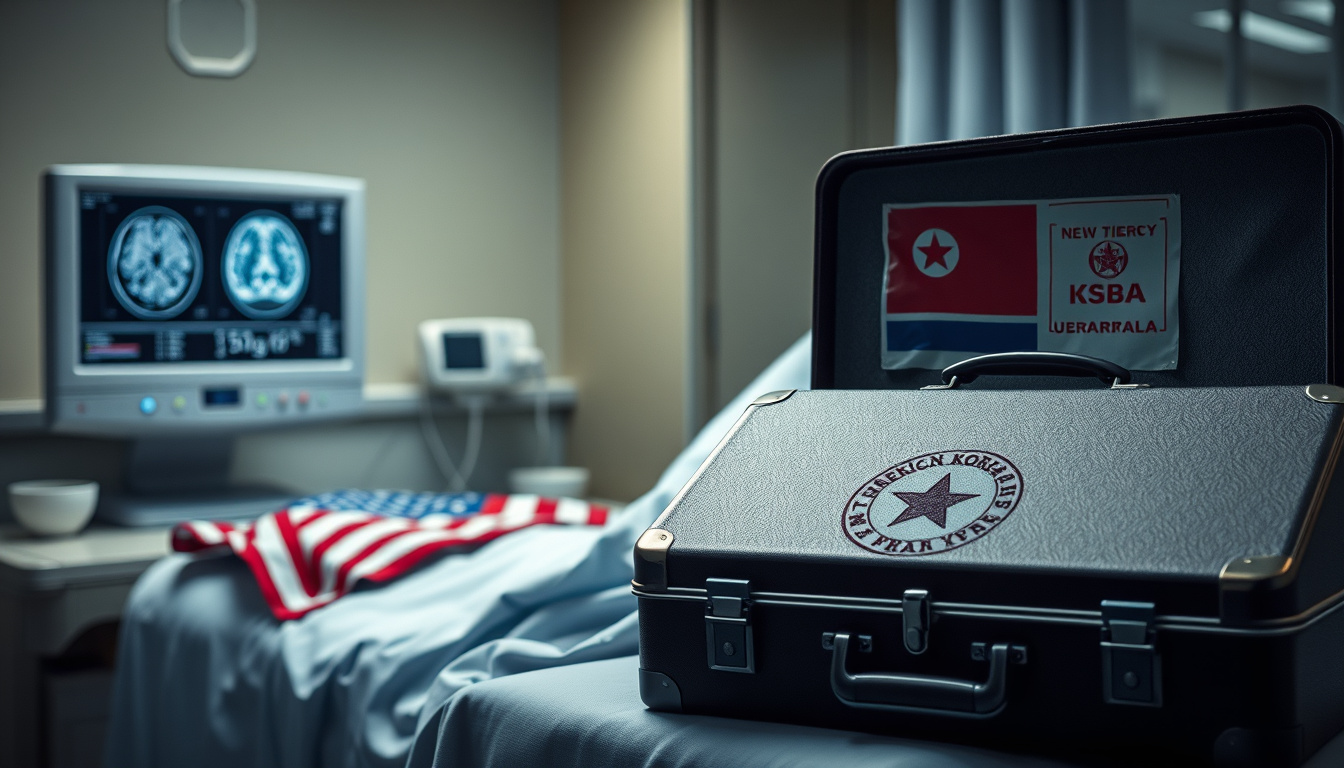
Otto Warmbier, the University of Virginia student who died after 17 months in North Korean custody, left a central medical mystery unresolved: North Korea says botulism and a sleeping pill caused his brain injury; U.S. doctors found a severe neurological injury of unknown cause. Here is what is confirmed, and what remains unanswered.
Date of arrest: January 2, 2016 ·
Date of death: June 19, 2017 ·
Sentence: 15 years hard labor ·
US medical diagnosis: Severe neurological injury of unknown cause
Quick snapshot
- Otto Warmbier, a University of Virginia student, arrested in January 2016 (Reuters (international news agency))
- Accused of stealing a propaganda poster from a hotel (BBC News) (Reuters (international news agency))
- Sentenced to 15 years hard labor (BBC News) (Reuters (international news agency))
- North Korea claimed botulism and sleeping pill caused coma (BBC News) (TIME (US news magazine))
- US doctors found severe neurological injury without clear cause (TIME (US news magazine))
- Lack of autopsy fuels speculation (ABC News) (TIME (US news magazine))
- US government engaged in negotiations, sent envoy Joseph Yun (Brookings Institution (Washington think tank))
- Warmbier released in June 2017 after 17 months (Reuters) (Brookings Institution (Washington think tank))
- Criticism of delayed or insufficient action (Brookings Institution) (Brookings Institution (Washington think tank))
- Family declined autopsy to preserve memory (ABC News)
- Public statements emphasized respect for Otto’s dignity (Fred Warmbier via ABC News)
- Contributed to ongoing uncertainty about cause of death (ABC News)
Four areas define the case: the arrest, the medical controversy, the diplomacy, and the family’s decision.
Seven key facts, one pattern: each official record raises more questions than it answers.
| Label | Value |
|---|---|
| Full name | Otto Frederick Warmbier |
| Born | December 12, 1994 |
| Died | June 19, 2017 |
| Arrested | January 2, 2016 |
| Sentence | 15 years hard labor |
| Official NK cause of death | Botulism and sleeping pill reaction |
| US medical diagnosis | Severe neurological injury, cause undetermined |
What caused Otto Warmbier’s brain injury?
North Korea’s official explanation
- North Korean authorities claimed Warmbier contracted botulism and then lapsed into a coma after taking a sleeping pill (BBC News (UK public broadcaster)).
- They told the U.S. side that he had been treated medically while in custody (Reuters).
U.S. doctors who returned from North Korea reportedly acknowledged that Warmbier had received medical care there, but they offered no independent confirmation of the botulism story (Reuters).
US medical findings
- Doctors at the University of Cincinnati Medical Center described Warmbier’s condition as a “severe neurological injury” and said he was in a state of unresponsive wakefulness (TIME (US news magazine)).
- Scans showed extensive loss of brain tissue across all regions (ABC News).
- The injury pattern was consistent with respiratory arrest or another event causing prolonged oxygen deprivation (NBC News).
- There was no evidence of active botulism when Warmbier was examined in Cincinnati (ABC News).
Doctors also said they saw no signs that Warmbier had been physically abused, while emphasizing they could not explain what caused the brain injury (BBC News).
Conflicting theories
- Speculation includes torture, oxygen deprivation from neglect, lack of medical care, or an undisclosed medical event.
- The Hamilton County coroner ruled the cause of death as “complications of chronic anoxic/ischemic encephalopathy due to unknown insult more than a year prior to death,” with manner of death undetermined (Voice of America (US government-funded media)).
- A coroner’s office review and virtual autopsy were unable to determine the original cause of the interrupted circulation and oxygen loss (The New York Times).
North Korea’s story—botulism plus a sleeping pill—is the only official explanation. U.S. doctors found no evidence for it, but they also found no evidence for any alternative. The medical record is a void.
What did doctors say about Warmbier’s condition?
Initial assessment upon return
- When Warmbier landed in Cincinnati on June 13, 2017, he was unresponsive and required full medical support (Reuters).
- Dr. Daniel Kanter of the University of Cincinnati Medical Center described the condition as “severe neurological injury” in a press conference (Associated Press (US news cooperative) via YouTube).
Neurological damage description
- Doctors reported that Warmbier had extensive brain damage and was in a state of unresponsive wakefulness—not a coma, but a condition where the body cycles through sleep-wake without awareness (TIME).
- Scans revealed “extensive loss of brain tissue” across all regions, consistent with prolonged oxygen deprivation (NBC News (US news outlet)).
Lack of definitive cause
- The medical team stated they could not determine the original cause of the brain injury despite extensive testing (BBC News).
- No evidence of trauma, infection, or active botulism was found (ABC News).
- The coroner’s report confirmed chronic anoxic/ischemic encephalopathy but left the “insult” as unknown (Voice of America).
The medical team gave the world a clear diagnosis of what happened—oxygen deprivation—but no explanation for why. That gap is the core of the mystery.
The implication: the doctors did their job. The information gap is not a medical failure but a political one—North Korea controlled the pre-return environment.
Why didn’t the US save Otto Warmbier?
Diplomatic efforts
- The U.S. State Department pursued diplomatic channels, including sending special envoy Joseph Yun to negotiate (Brookings Institution (Washington think tank)).
- Yun traveled to North Korea in March 2017, but the regime refused to release Warmbier until after the Trump administration took office (Reuters).
- U.S. officials described the return as a “humanitarian” gesture by North Korea (Reuters).
Sanctions and negotiations
- The U.S. had imposed sanctions on North Korea over its nuclear program, limiting leverage.
- Critics argue that the U.S. could have acted more aggressively earlier in Warmbier’s detention, perhaps by sending a higher-level envoy or offering a more tangible concession.
- North Korea’s pattern of using foreign detainees as bargaining chips was well known.
Criticism of US response
- Some analysts and family members believe the U.S. government did not prioritize Warmbier’s case enough during the Obama administration (Brookings Institution).
- Joseph Yun later faced criticism for a lack of transparency about the negotiations.
- Warmbier’s case became a major flashpoint in U.S.-North Korea diplomacy and criticism of Pyongyang’s detention practices (Brookings Institution).
The U.S. government pursued quiet diplomacy, but North Korea’s timeline—release only after a new administration—suggests the regime was playing a longer game. The result: a young man died before any deal was reached.
The trade-off: aggressive diplomacy might have secured Warmbier’s release earlier, but could also have been perceived as rewarding hostage-taking. The United States chose the conventional path, and it failed.
What did North Korea do to Otto Warmbier on Reddit?
Reddit discussions and theories
- On Reddit, users speculate about torture, medical neglect, and staged confessions.
- Some threads claim Warmbier was subjected to forced labor, starvation, and psychological abuse.
- Others argue that the botulism story is a cover-up for a deliberate act of harm.
Allegations of mistreatment
- Allegations include beatings, sensory deprivation, and denial of medical care.
- No independent verification exists for any Reddit claim; the North Korean government has consistently denied mistreatment.
- U.S. doctors found no signs of physical abuse, but they could not rule it out (BBC News).
Conspiracy narratives
- Some Reddit users theorize that the U.S. government knew more than it disclosed, or that Warmbier was used as a pawn in a larger geopolitical game.
- Other narratives suggest the brain injury was caused by a botched North Korean interrogation technique.
None of these theories have been substantiated. The official North Korean account is widely disbelieved, but no alternative has been proven.
The pattern: in the absence of official transparency, online communities fill the void with speculation. Reddit is a symptom of the information vacuum, not a source of evidence.
Why did Otto Warmbier’s family not want an autopsy?
Family’s statement
- Fred Warmbier, Otto’s father, stated that the family did not want an autopsy to “preserve the memory of Otto” (ABC News (US network)).
- They felt that an autopsy would be an additional violation of his dignity.
Consequences of the decision
- The lack of a full autopsy left the precise cause of death unresolved in the public record.
- A coroner’s office review and virtual autopsy were conducted, but they could not determine the original cause of the oxygen deprivation (The New York Times (major US newspaper)).
- The family’s decision has been criticized by some who argue that a full autopsy would have provided answers and accountability.
The family chose dignity over closure. Their right to make that choice is unimpeachable, but the result is that the world may never know exactly what happened to Otto Warmbier inside North Korea.
The implication: for the rest of us, the unanswered question endures. The family’s private grief became a public mystery—one that continues to fuel debate and distrust.
Timeline
- January 2, 2016 – Otto Warmbier arrested at Pyongyang airport while departing North Korea (Reuters).
- March 16, 2016 – Sentenced to 15 years of hard labor for subversion (BBC News).
- June 2016 – Warmbier reportedly lapses into coma; North Korea claims botulism (BBC News).
- June 13, 2017 – Warmbier released to US custody, flown to Cincinnati (Reuters).
- June 19, 2017 – Otto Warmbier dies at University of Cincinnati Medical Center (Reuters).
- June 20, 2017 – Family announces no autopsy will be performed (ABC News).
The timeline narrows the mystery to the months between the reported coma and the release, but it does not resolve them.
What we know, what remains unclear
Confirmed facts
- Warmbier was arrested, sentenced, and held for 17 months (Reuters).
- He returned to the US in a coma and died shortly after (Reuters).
- US doctors found severe neurological injury with no clear cause (TIME).
- Family refused autopsy (ABC News).
What’s unclear
- Exact cause of brain injury (torture, disease, accident?).
- Whether North Korea’s botulism claim is true.
- Extent of US diplomatic efforts and their timing.
- What happened to Warmbier during his detention.
The confirmed facts are few; the unresolved questions define the case. That asymmetry is why the official narratives remain contested.
Key statements from those involved
“He had a severe neurological injury, and he was in a state of unresponsive wakefulness.”
— Dr. Daniel Kanter, University of Cincinnati Medical Center (Associated Press)
“He contracted botulism and then lapsed into a coma after taking a sleeping pill.”
— North Korean state media (BBC News)
“We wanted to preserve the memory of Otto.”
— Fred Warmbier, father (ABC News)
“We engaged in negotiations, but North Korea refused to release him until after the new administration.”
— Joseph Yun, US special envoy (Brookings Institution)
For the Biden administration, the Warmbier case remains a cautionary tale about the limits of diplomacy with Pyongyang: negotiate too late, and the cost is measured in lives.
Related reading: George W. Bush: Presidency, Legacy, and Controversies · Mao Zedong Biography: Legacy, Policies, and Modern View
Frequently asked questions
What charge was Otto Warmbier convicted of?
He was convicted of “subversion” for attempting to steal a propaganda poster from a hotel in Pyongyang (BBC News).
How long was Otto Warmbier detained in North Korea?
He was detained for 17 months, from January 2, 2016 to June 13, 2017 (Reuters).
What was the US government’s official response to his detention?
The US State Department engaged in diplomatic negotiations, including sending special envoy Joseph Yun, but North Korea refused an early release (Brookings Institution).
What did North Korea claim concerning the propaganda poster?
North Korea claimed Warmbier stole a propaganda poster with a political slogan from a restricted area of his hotel (BBC News).
Why was an autopsy not performed?
The family decided against an autopsy to preserve Otto’s dignity and memory (ABC News).
Are there alternative theories about the cause of his brain injury?
Yes, speculation includes torture, oxygen deprivation from neglect, a botched interrogation, or an undiagnosed medical condition. None have been verified.
What diplomatic actions were taken by the US before his release?
The US sent special envoy Joseph Yun to Pyongyang in March 2017, and the State Department pursued bilateral channels. North Korea released Warmbier only after the Trump administration took office (Reuters).
These questions capture the public record, but without an autopsy or independent access to Warmbier’s detention, the full answer remains out of reach.
Related stories





Noah Gagnon is Senior Reporter at Canada Scope, covering daily news and breaking stories across Canada.