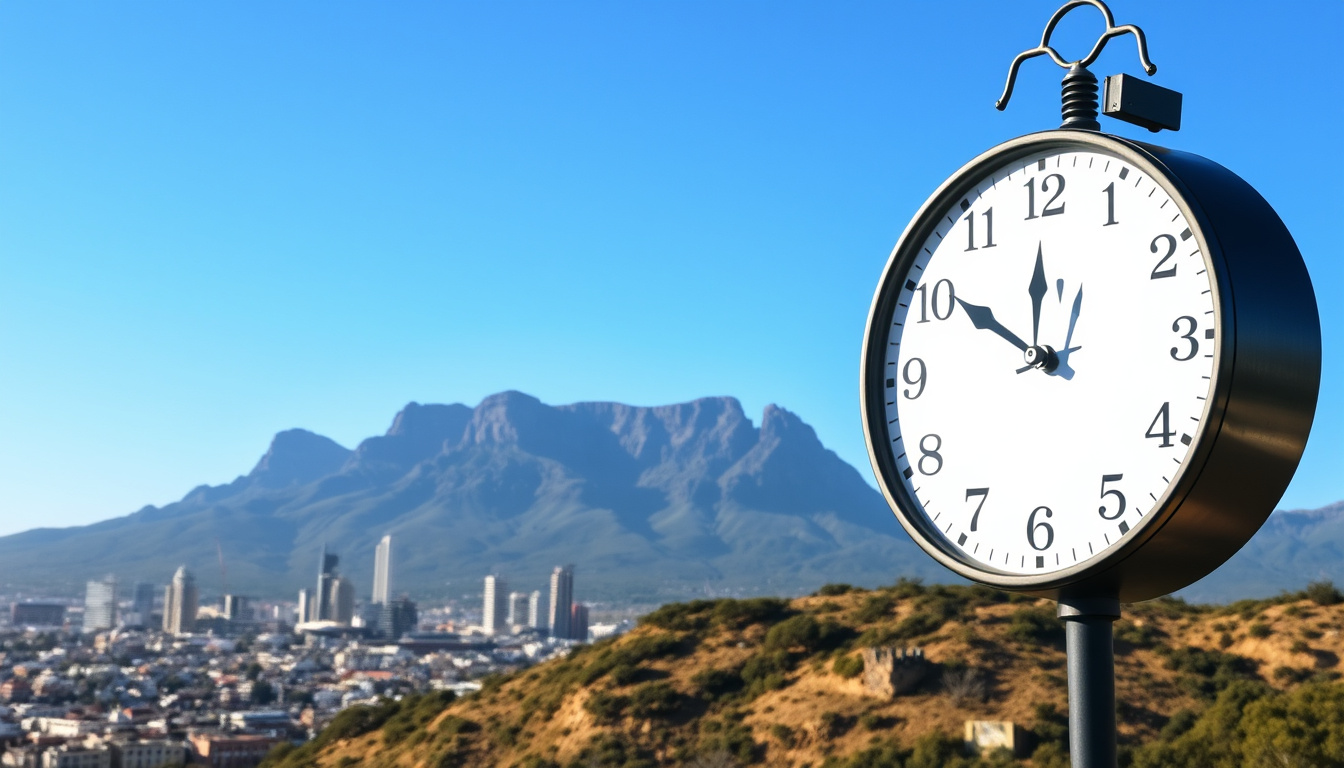

Planning a call with colleagues in Johannesburg or wondering what time it is in Cape Town right now? South Africa keeps things refreshingly simple — one time zone, no seasonal clock shifts, just steady UTC+2 from Durban to the Cape. This guide gives you the exact current time across major cities, explains the SAST zone, and shows you how South Africa stacks up against the US, UK, and beyond.
Time Zone: South Africa Standard Time (SAST) · UTC Offset: UTC+2 · Daylight Saving: Not observed · Major Cities: Johannesburg, Cape Town, Durban · Current Example: Thu 6:13 pm (varies by source)
Quick snapshot
- Same UTC+2 as Johannesburg (time.is)
- No time difference between the cities (time.is)
- Western Cape province (Worldometer)
- Also on SAST (UTC+2) (WorldTimeServer.com)
- Single zone nationwide (WorldTimeServer.com)
- KwaZulu-Natal province (WorldTimeServer.com)
- No DST observed (since 1944) (time.is)
- 2 hours ahead of GMT (WorldTimeServer.com)
- One zone for entire country (WorldTimeServer.com)
What’s the right time in South Africa now?
The right time in South Africa applies uniformly across the entire nation. Unlike countries with multiple regional time zones, South Africa operates on a single clock from Cape Town to Durban to Johannesburg (WorldTimeServer.com). SAST (South Africa Standard Time) runs at UTC+2 year-round with no daylight saving adjustments (time.is).
Johannesburg and Cape Town share the same UTC+2 offset under the Africa/Johannesburg IANA time zone identifier (time.is). Whether you check the clock in Gauteng province or the Western Cape, the time is identical — no conversion needed between South Africa’s major cities (time.is).
For travelers and remote workers, South Africa’s single time zone means zero mental math between cities. Fly from Johannesburg to Cape Town and your watch doesn’t change.
The practical value of this uniformity extends beyond convenience. International business callers scheduling meetings across South African cities never need to account for internal time gaps — a small but meaningful advantage for coordination.
Is South Africa 1 or 2 hours ahead?
South Africa runs 2 hours ahead of Greenwich Mean Time — its UTC+2 offset is fixed year-round (WorldTimeServer.com). The country does not observe daylight saving time, so that 2-hour gap stays constant regardless of season (time.is).
The last daylight saving adjustment in South Africa was in 1944 — nearly eight decades without seasonal clock shifts (time.is). No DST changes are on the horizon for 2026 or beyond (24timezones.com).
Business callers from abroad planning meetings across South African cities never need to account for a time gap. Whether reaching Durban or Pretoria, UTC+2 applies.
This permanence gives South Africa a reliability that time zone travelers in other regions cannot count on — when your counterparts’ clocks stay put, scheduling becomes predictable.
Are there two time zones in South Africa?
No. All of South Africa uses SAST (UTC+2) — one time zone from Musina in the north to Cape Town in the south (WorldTimeServer.com). The IANA identifier Africa/Johannesburg covers every location in the country (time.is).
Business callers from abroad planning meetings across South African cities never need to account for a time gap. Whether reaching Durban or Pretoria, UTC+2 applies.
What time is it in South Africa compared to other regions?
South Africa runs 6 hours ahead of New York during April (Eastern Daylight Time) and 7 hours ahead when New York returns to Eastern Standard Time in November (time.is). Cape Town sits 9 hours ahead of Los Angeles while Pacific Daylight Time is active, shrinking to 8 hours when Los Angeles switches to PST (savvycal.com).
The gap to Chicago changes by season as well: 7 hours ahead during CDT, 8 hours when Chicago runs on CST. For anyone scheduling calls, these daylight saving shifts require attention twice a year (savvycal.com).
The implication for international callers: when you factor in South Africa’s fixed offset against DST-observing countries, the effective gap shifts twice yearly, making calendars less predictable than they appear at first glance.
| Label | Value |
|---|---|
| Standard Time | SAST (UTC+2) |
| DST Observed | No |
| Time Zones Count | 1 |
| Example Time | Thu 6:13 pm |
| Key Site | timeanddate.com |
| IANA Identifier | Africa/Johannesburg |
| DST Last Used | 1944 |
| Johannesburg Province | Gauteng |
| Cape Town Province | Western Cape |
| Hours Ahead of New York | +6 (EDT in April) |
“Johannesburg has not had daylight saving time since 1944.”
“Cape Town has not had daylight saving time since 1944.”
Related reading: South Africa National Cricket Team Timeline · Time Facts
worldtimeserver.com, arahr.com, time.now, worldtimeserver.com, zeitverschiebung.net, zeitverschiebung.net
Frequently asked questions
What time is it in south africa now am or pm?
South Africa uses the 12-hour clock for most civilian timekeeping, displaying time as “6:13 pm” or “9:30 am” in everyday use.
What is the South Africa time zone?
SAST stands for South Africa Standard Time, running at UTC+2 as the country’s single time zone (WorldTimeServer.com).
Does South Africa observe daylight saving time?
No. Daylight saving time has not been observed since 1944, and no DST changes are planned for 2026 (24timezones.com).
What time is it in South Africa compared to GMT?
South Africa runs 2 hours ahead of GMT (UTC+2) (WorldTimeServer.com).
How many time zones does South Africa have?
One. SAST (UTC+2) applies from Musina in the north to Cape Town in the south.
What is current time in Pretoria South Africa?
Pretoria sits in Gauteng province alongside Johannesburg and uses SAST (UTC+2) — identical to the rest of the country.
South Africa time now vs India?
India operates at UTC+5:30, making South Africa 3 hours 30 minutes behind Indian Standard Time.
Related stories




Hannah Walsh covers federal and provincial politics and public policy for Canada Scope.