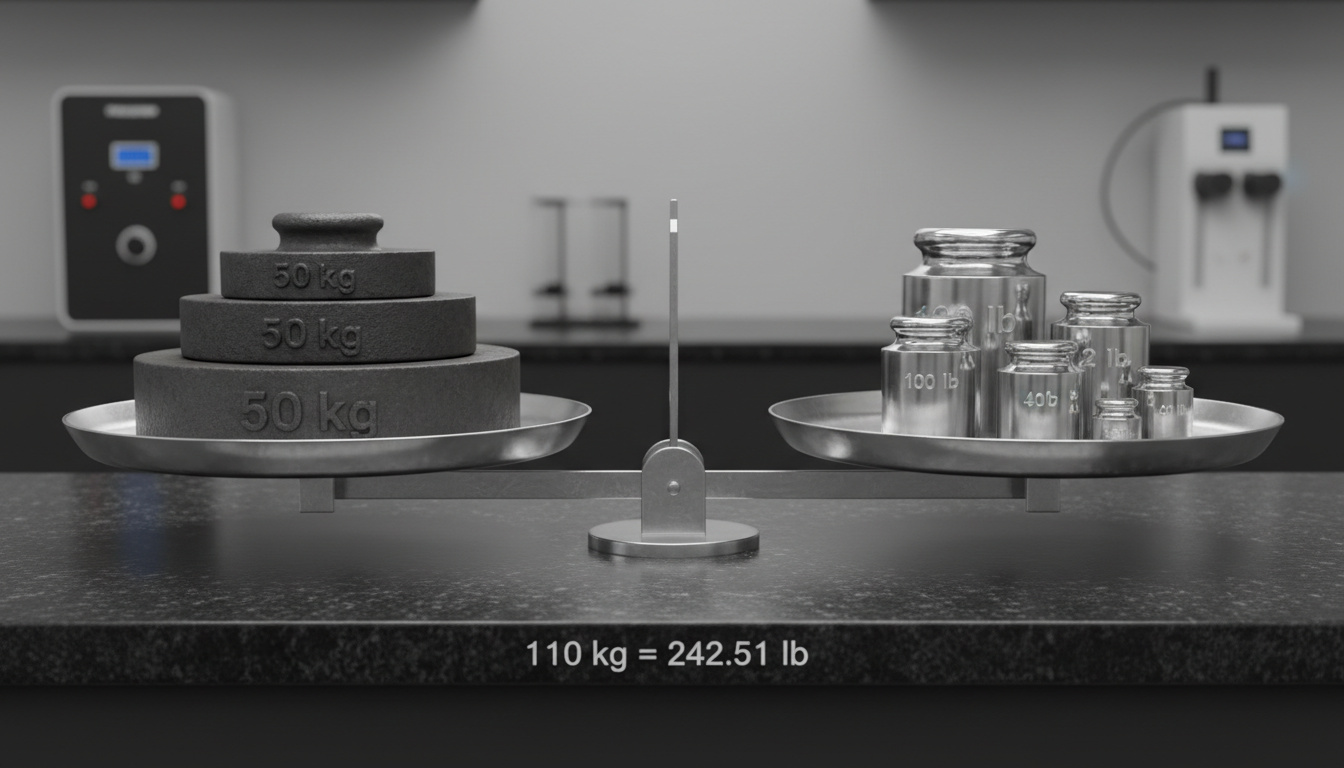
One hundred ten kilograms equals exactly 242.508488403 pounds under international standards.
This specific conversion matters for travelers switching between metric and imperial regions, athletes tracking lifting progress, and shipping companies calculating freight charges. The figure represents more than a rounded estimate; it reflects a precise mathematical relationship defined by the 1959 International Yard and Pound Agreement.
Understanding the exact value prevents cumulative errors in scientific calculations, medical dosing, and engineering specifications where approximations of 242.5 or 243 pounds would introduce unacceptable variance.
What is 110 kg in pounds?
242.5085 lbs
242.5 lbs
×2.20462
Mass/Weight
The conversion relies on the exact factor 2.20462262185 pounds per kilogram, established through the 1959 international agreement fixing 1 pound at precisely 0.45359237 kilograms. This standard eliminated previous variations between US and UK pound definitions.
- Use the full multiplier 2.20462262185 for scientific accuracy
- 110 kg converts to approximately 17 stone 5 pounds in UK measurement
- Fitness contexts frequently reference this weight for advanced bench press benchmarks
- International shipping scales require precision to avoid tariff miscalculations
- Rounding to 242.5 lbs introduces only 0.0085 lbs error, acceptable for most daily use
- Avoirdupois pounds (standard weight) differ from troy pounds (precious metals)
- The kilogram remains the sole SI base unit with a physical artifact history
| Kilograms | Pounds (exact) | Pounds (rounded) | Stone |
|---|---|---|---|
| 100 kg | 220.4623 lbs | 220.5 lbs | 15.75 st |
| 105 kg | 231.4854 lbs | 231.5 lbs | 16.53 st |
| 110 kg | 242.5085 lbs | 242.5 lbs | 17.32 st |
| 115 kg | 253.5316 lbs | 253.5 lbs | 18.11 st |
| 120 kg | 264.5547 lbs | 264.6 lbs | 18.90 st |
For additional conversion tools, visit our kg to lbs converter.
How do you convert kg to lbs?
The mathematical foundation
The standard formula is lb = kg × 2.20462262185. This multiplier derives from the exact reciprocal relationship where 1 pound equals 0.45359237 kilograms, fixed by the 1959 international yard-pound agreement. The National Institute of Standards and Technology (NIST) maintains this conversion factor as the authoritative standard for all US measurements.
Step-by-step calculation for 110 kg
Multiply 110 by 2.20462262185. The calculation yields 242.5084884035 pounds. For practical purposes, truncate to two decimal places: 242.51 pounds. For stone conversions, divide the pound result by 14: 242.5085 ÷ 14 = 17.322 stone, or 17 stone 4.51 pounds.
Precision versus approximation
Common simplified multipliers like 2.2 or 2.205 create significant errors at higher weights. Using 2.2 for 110 kg yields 242 pounds, an understatement of 0.5085 pounds. While negligible for luggage fees, such discrepancies compound in laboratory settings or pharmaceutical dosing.
The avoirdupois pound was legally defined as exactly 0.45359237 kg in 1959 by the US and UK, based on the international yard-pound agreement. This yields the exact multiplier 2.20462262185 used in scientific contexts.
Common kg to lbs conversions near 110 kg
100 kg to lbs
One hundred kilograms equals exactly 220.4623 pounds, typically rounded to 220.5 pounds. This represents roughly 15 stone 11 pounds. In fitness contexts, a 100 kg bench press serves as an intermediate-advanced milestone for male lifters.
110 kg to stone and pounds
British and Irish medical records often express 110 kg as 17 stone 4.5 pounds. The calculation uses the exact pound value divided by 14, since one stone equals 14 avoirdupois pounds. Conversion tools verify that 242.5085 pounds ÷ 14 = 17.322 stone.
120 kg to lbs
One hundred twenty kilograms converts to 264.5547 pounds, or approximately 18 stone 13 pounds. In powerlifting, 120 kg (265 lb) represents an elite-level bench press for most bodyweight classes.
While the UK officially uses metric units for trade, stone remains prevalent for human body weight in medical and casual contexts. 110 kg converts to 17 stone 5 pounds, though precise medical records may use kilograms exclusively.
When did the kilogram-pound standard emerge?
- : The French National Convention establishes the metric system, defining the kilogram as the mass of one liter of water at freezing point.
- : The General Conference on Weights and Measures creates the International Prototype Kilogram (IPK), a platinum-iridium cylinder serving as the physical standard.
- : The United States, United Kingdom, Canada, Australia, New Zealand, and South Africa sign the international yard-pound agreement, fixing the pound at exactly 0.45359237 kilograms and establishing the modern conversion factor.
- : The kilogram is redefined via the Planck constant, eliminating dependence on physical artifacts, though the numerical value remains unchanged for practical conversions.
The 1959 standardization eliminated previous discrepancies where US and UK pounds differed by approximately 0.0002 pounds, ensuring global uniformity in trade and science.
What aspects of 110 kg conversions require context?
Established Facts
- Exact conversion: 242.508488403 pounds
- Formula: kg × 2.20462262185
- Fixed by international treaty since 1959
- NIST maintains official US standards
Context-Dependent Interpretations
- Health assessments require height/BMI calculation
- Fitness classifications vary by gender and experience
- Shipping categories differ by carrier thresholds
- Medical “overweight” definitions vary by jurisdiction
Whether 110 kg constitutes a healthy weight depends entirely on height, body composition, and muscle mass. At 1.8 meters tall, 110 kg yields a BMI of 33.9, classified as obese by WHO standards, yet elite athletes with high muscle mass may carry this weight without metabolic risk.
In strength training, a 110 kg (242.5 lb) bench press represents an elite benchmark for men weighing 90-100 kg, while for women it ranks as exceptional. However, competitive standards vary significantly between powerlifting federations and recreational fitness assessments.
Why do both kilograms and pounds persist globally?
The kilogram serves as the SI base unit for mass, used universally in scientific research, medicine, and international trade. The United States, Myanmar, and Liberia still use pounds and ounces for commercial and everyday purposes, creating the need for precise conversions in logistics, aviation, and athletics.
Historical inertia maintains the pound in US construction, real estate, and sports. A 110 kg athlete competes in metric-weight classes internationally but may train using 242.5 lb barbell plates in American gyms. This dual-system reality necessitates exact conversion knowledge to prevent equipment errors.
Our weight conversion guide provides additional context for navigating these systems.
Which authorities define these conversion standards?
The National Institute of Standards and Technology (NIST) maintains the official US conversion factors, while the International Bureau of Weights and Measures (BIPM) coordinates global standards. Both derive authority from the 1959 international agreement and the 2019 SI redefinition.
1 kg = 2.20462262185 lb (exact by definition)
— NIST Handbook 44 and the International Yard-Pound Agreement of 1959
The exact mathematical relationship remains unchanged since 1959, providing the certainty required for legal trade, pharmaceutical manufacturing, and aerospace engineering.
How should you apply this conversion?
Use 242.5085 pounds when calculating shipping costs, medical dosages, or scientific measurements where precision prevents costly errors. For gym weights, 242.5 pounds suffices, understanding that barbell plates typically come in 2.5-pound increments requiring rounding. Always verify whether your specific context requires exact values or acceptable approximations.
Frequently asked questions
Is 110 kg overweight?
At most heights, yes. For a 1.8 m person, 110 kg produces a BMI of 33.9, classified as obese. However, muscular athletes may carry this weight healthily.
What is 110 kg bench press in lbs?
110 kg equals 242.5 pounds. This represents an elite lifting benchmark for most men and an exceptional achievement for women.
What is 110 kg to stone?
110 kg converts to approximately 17.3 stone, or exactly 17 stone 4.5 pounds.
How many ounces are in 110 kg?
Multiply 242.5085 pounds by 16 ounces per pound. 110 kg equals 3,880.136 ounces exactly.
Is 242 lbs exactly 110 kg?
No. 242 lbs equals approximately 109.77 kg. The exact 110 kg value is 242.5085 pounds.
Why is the conversion factor not exactly 2.2?
2.2 is a rounded approximation. The exact factor is 2.20462262185, derived from 1 pound equaling exactly 0.45359237 kilograms.
Does water freeze at 110 kg?
Mass does not determine freezing points. One liter of water (1 kg) freezes at 0°C regardless of total mass.
Related stories





Hannah Walsh covers federal and provincial politics and public policy for Canada Scope.