
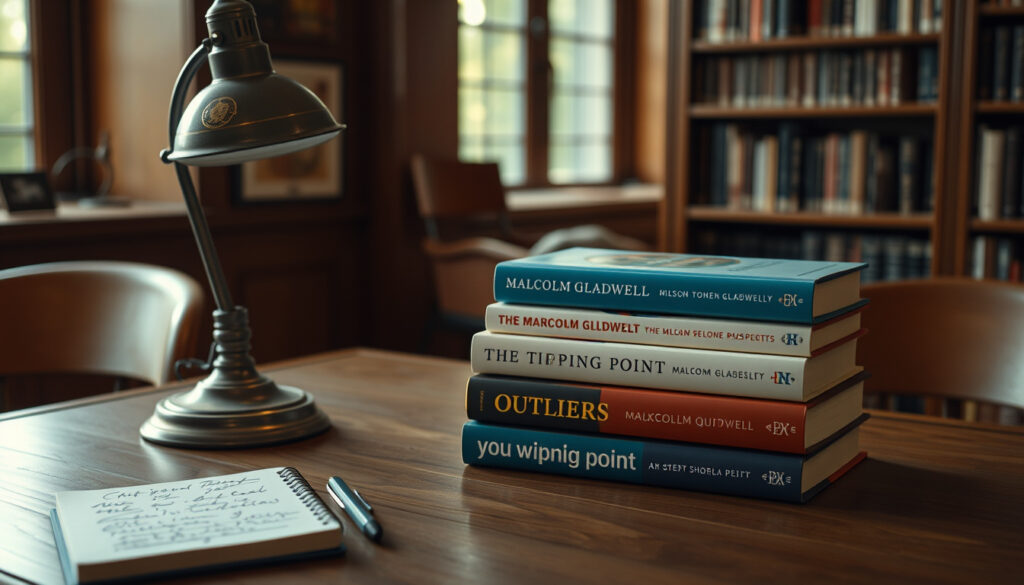
You’ve probably heard the name Malcolm Gladwell. Maybe you’ve read his books, listened to his podcast, or seen his TED talks. But who is the man behind the ideas that have shaped how we think about success, trends, and human behavior? This profile pulls together his biography, biggest works, the criticisms that follow him, and the personal details fans often ask about.
Full name: Malcolm Timothy Gladwell ·
Born: September 3, 1963, Fareham, England ·
Occupation: Journalist, author, public speaker ·
Notable books: The Tipping Point, Blink, Outliers, David and Goliath ·
Podcast: Revisionist History ·
Citizenship: British-Canadian
Quick snapshot
- Born September 3, 1963 in Fareham, England (Celebrity Net Worth (finance data site))
- Staff writer at The New Yorker since 1996 (Amazon author page (retail profile))
- Five New York Times bestsellers including The Tipping Point, Blink, Outliers (Malcolm Gladwell official site (primary source))
- Exact current net worth (private finances; estimates range $30M–$50M)
- Formal political party affiliation (self-described liberal, not a party member)
- Precise academic citation counts debated
- 2000: The Tipping Point published, creates a new genre of social science narrative (Britannica (encyclopedia))
- 2016: Launches Revisionist History podcast (Britannica (encyclopedia))
- 2024: Publishes Revenge of the Tipping Point (Britannica (encyclopedia))
- Continued podcasting and speaking tours
- Potential new book topics (no confirmed projects announced)
- Ongoing academic debate over his methods
Ten facts about Gladwell, from his birth to his current work, show a clear pattern: a career built on translating dense academic research into accessible stories.
| Label | Value |
|---|---|
| Full name | Malcolm Timothy Gladwell |
| Date of birth | September 3, 1963 |
| Place of birth | Fareham, England |
| Nationality | British-Canadian |
| Occupation | Author, journalist, public speaker |
| Years active | 1987–present |
| Notable works | The Tipping Point, Blink, Outliers, David and Goliath |
| Spouse | Kate Gladwell |
| Children | Two daughters |
| Awards | Order of Canada (CM) |
Gladwell’s formula — story-driven social science — has made him a household name but left scholars questioning the accuracy of his conclusions.
What is Malcolm Gladwell famous for?
Defining his genre: the social science storyteller
- Gladwell is a British-Canadian journalist and author known for popularizing academic research through narrative non-fiction. His books focus on unexpected patterns in social behavior and psychology. (Britannica (encyclopedia))
- His first book, The Tipping Point (2000), became a bestseller and established his signature approach: taking a sociological concept and wrapping it in compelling stories. (Britannica (encyclopedia))
His role as a New Yorker staff writer
- Gladwell joined The New Yorker in 1996 as a staff writer, a position he still holds. He previously worked as a reporter at The Washington Post. (Amazon author page (retail profile))
- His magazine pieces often previewed the ideas that later became his books. The combination of long-form journalism and mass-market books made him one of the most recognizable nonfiction authors of the 2000s.
Gladwell’s fame rests on a single talent: turning peer-reviewed studies into page-turners. Readers get a shortcut to complex ideas, and Gladwell gets a bestselling career. The trade-off is that nuance often gets left behind.
The pattern: Gladwell makes social science digestible, but the process strips away the caveats researchers insist upon.
What are the criticisms of Malcolm Gladwell?
Claims of oversimplification
- Academics have argued that Gladwell oversimplifies complex research and selectively uses data. The New York Times called Outliers “glib, poorly reasoned, and thoroughly unconvincing.” (The Guardian (UK news))
- Many academics criticize his use of anecdotes rather than systematic data analysis. (Canadian Wire (online journalism))
Accuracy concerns from academics
- His work is criticized for drawing broad conclusions from limited or anecdotal evidence. For example, the “10,000-hour rule” from Outliers has been challenged by researchers who argue practice is only one factor in expertise.
- Gladwell has publicly said he is “just trying to start a conversation” in response to criticism. (The Guardian (UK news))
For readers wanting a quick takeaway, Gladwell’s stories are satisfying. For researchers, they can feel like a caricature of their field. The real casualty is public trust in social science when the nuance gets lost.
The implication: Gladwell’s defenders say he popularizes ideas; his critics say he distorts them. Both are right.
Who is Malcolm Gladwell’s partner?
His personal life
- Gladwell is married to Kate Gladwell. They have two daughters. (The City Celeb (celebrity biography site))
- His wife supports his career, managing household and personal logistics.
Family information
- Gladwell was born in England and grew up in rural Ontario, Canada. (Amazon author page (retail profile))
- He has two daughters with Kate. The family maintains a relatively private life outside his public appearances.
What this means: Gladwell keeps his domestic life guarded, a contrast to his public persona as an ideas celebrity.
What is Malcolm Gladwell’s politics?
Public political leanings
- Gladwell has described himself as a liberal or progressive. (Canadian Wire (online journalism))
- He has criticized systemic inequality and privilege in his books, especially in Outliers and David and Goliath.
Political themes in his work
- Conservatives have questioned his argument about privilege and systemic advantage in Outliers. (Canadian Wire (online journalism))
- Progressives have critiqued his defense of broken-windows policing in later work. (Canadian Wire (online journalism))
The catch: Gladwell draws fire from both sides — a sign that his politics are more about storytelling than party loyalty.
What is Malcolm Gladwell’s best book?
The Tipping Point and its legacy
- The Tipping Point is often considered his most influential work. It introduced the concept of tipping points for social trends and sold millions of copies. (Britannica (encyclopedia))
- It spent many weeks on the New York Times bestseller list and is still widely read in business and marketing circles.
Outliers and the 10,000-hour rule
- Outliers (2008) introduced the widely cited 10,000-hour rule, which claims that mastery requires about 10,000 hours of deliberate practice. (Britannica (encyclopedia))
- The rule has been debated in academic circles, but it remains one of the most popular pop-psychology concepts of the 2000s.
For readers deciding which Gladwell book to start with, The Tipping Point offers the most original framework, while Outliers is the most talked-about. The 10,000-hour rule alone has shaped how millions think about skill development.
The pattern: Gladwell’s best-known books are the ones that produce a single, sticky idea — whether or not the idea survives academic scrutiny.
How rich is Malcolm Gladwell?
Estimated net worth
- His net worth is estimated between $30 million and $50 million. Celebrity Net Worth lists $30 million. (Celebrity Net Worth (finance data site))
- A 2026 Fortune article also refers to an estimated $30 million net worth. (Fortune (business magazine))
Sources of income
- Primary income comes from book sales, speaking fees (often six figures per engagement), and his podcast Revisionist History.
- Gladwell has said that extreme wealth is “quite crippling to motivation” in a 2026 Fortune interview. (Fortune (business magazine))
The implication: Even as Gladwell questions the value of extreme wealth, his own multi-million-dollar earnings continue from the very system he critiques.
Timeline
- – Born in Fareham, England. (Celebrity Net Worth (finance data site))
- – Began journalism career at The American Spectator.
- – Joined The New Yorker as a staff writer. (Amazon author page (retail profile))
- – Published The Tipping Point, his first bestseller. (Britannica (encyclopedia))
- – Launched the podcast Revisionist History.
- – Published Revenge of the Tipping Point.
Confirmed facts vs. uncertainties
Confirmed facts
- Birth date and place (September 3, 1963, Fareham, England)
- Marital status (married to Kate Gladwell, two daughters)
- Names of his books (The Tipping Point, Blink, Outliers, David and Goliath, etc.)
- Podcast title (Revisionist History)
- Estimated net worth range ($30M–$50M)
What’s unclear
- Precise current net worth (private finances, estimates vary)
- Political party affiliation (self-described liberal, not formally registered)
- Some academic citation counts (debated among researchers)
Quotes on Gladwell
I’m just trying to start a conversation.
Malcolm Gladwell, in response to criticism (as reported by The Guardian (UK news))
Extreme wealth is quite crippling to motivation.
Malcolm Gladwell, in a 2026 Fortune interview (Fortune (business magazine))
For readers who want to understand the man behind the ideas, the pattern is clear: Gladwell is a master storyteller who has made social science accessible, but at a cost. For academics, his work is a warning about the dangers of oversimplification. For the general public, it’s a gateway to thinking about how the world works. The choice is simple: read him as entertainment, not as a textbook.
Related reading: Malcolm Gladwell: Books, Theories, and Criticisms · Tony Robbins Facts: Net Worth, Sleep, Health & Life
coed.com, greatpeoplebios.com, hollywoodmask.com, books.google.com
Frequently asked questions
Why is Malcolm Gladwell controversial?
He is criticized for oversimplifying complex research and selectively using data to support his arguments. Many academics find his work “glib” and “poorly reasoned.” (The Guardian)
What is the 10,000-hour rule?
A concept from Outliers that claims 10,000 hours of deliberate practice is needed to achieve mastery in any field. It has been debated in academic circles.
What is the Tipping Point about?
The book explains how small actions can trigger large social trends, using the concept of a “tipping point” borrowed from epidemiology.
How did Malcolm Gladwell become famous?
He gained fame through his 1996 New Yorker articles and the 2000 publication of The Tipping Point, which became a massive bestseller.
Has Malcolm Gladwell won any awards?
Yes, he is a member of the Order of Canada (CM) and has received numerous journalism awards.
Is Malcolm Gladwell still writing books?
Yes, he published Revenge of the Tipping Point in 2024 and continues to write and podcast.
Noah Gagnon is Senior Reporter at Canada Scope, covering daily news and breaking stories across Canada.