
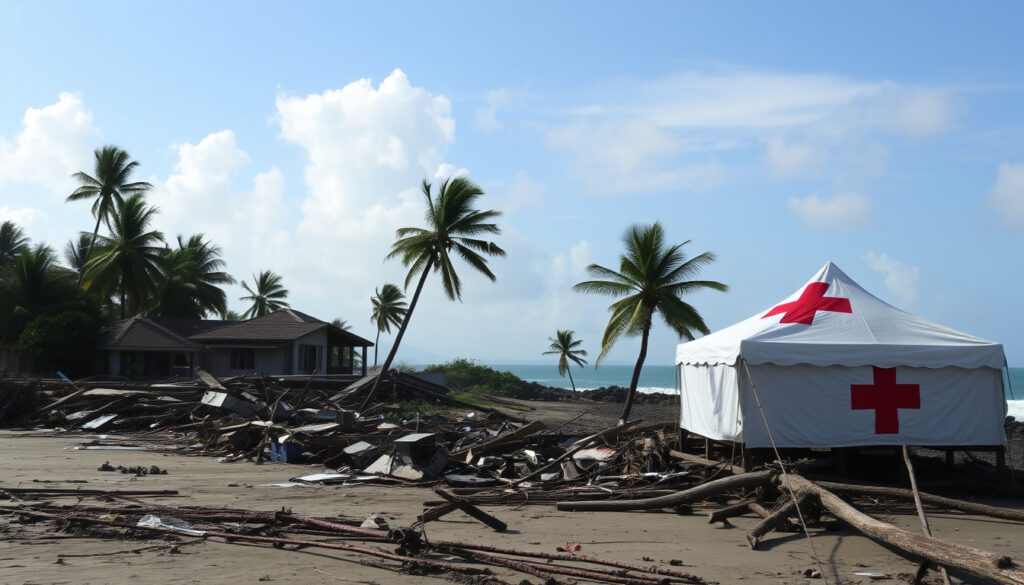
When a storm with 185 mph winds barrels toward your island, the first question is always about survival. Hurricane Melissa, which struck Jamaica in late October 2025, did exactly that — and the numbers that followed tell a story that’s still being written.
Minimum reported death toll: 28 (BBC) · Higher death toll estimate: 45 (The Guardian) · People still missing: 13 · Maximum sustained winds at landfall: 185 mph · Affected households: 90,000 · Total people affected: 360,000
Quick snapshot
- Melissa made landfall as a Category 5 hurricane on Oct. 28, 2025 (Center for Disaster Philanthropy)
- Wind speeds reached 185 mph at landfall (Center for Disaster Philanthropy)
- 90,000 households were damaged (The Guardian)
- At least 28 people died (BBC minimum) (BBC Weather)
- Exact final death toll (28 vs 45)
- Number of missing persons (13 reported, may still change)
- Full timeline of recovery completion
- Exact number of displaced people (360,000 reported, could change)
- Oct. 28, 2025: Melissa makes landfall as Category 5 (Center for Disaster Philanthropy)
- Within weeks: death toll reported as 45 by The Guardian
- Three months later: most power and water restored (Direct Relief)
- Recovery continues with over $11.5 million in aid delivered (Direct Relief)
- Tourist areas partially reopened, some regions still inaccessible (Direct Relief)
The table below captures the key numbers from the storm’s aftermath.
| Official minimum death toll | 28 (BBC) |
| Higher estimate | 45 (The Guardian) |
| People missing | 13 |
| Maximum sustained winds | 185 mph |
| Landfall date | Late October 2025 |
| Saffir-Simpson category | 5 |
| Affected households | 90,000 |
| Total affected people | 360,000 |
How many people died in Hurricane Melissa in Jamaica?
Official vs. independent death toll estimates
The lowest official count comes from BBC Weather (UK public broadcaster), which reported at least 28 deaths in Jamaica. But a more comprehensive analysis by The Guardian (respected global news outlet) put the figure at 45, with 13 people still missing. That gap is not unusual in the aftermath of a major hurricane — the chaos of search and rescue, plus infrastructure failures, makes a firm count difficult.
Eight facts, one pattern: the death toll rose as reporting deepened. By early November 2025, the Center for Disaster Philanthropy (nonprofit disaster research group) noted 45 confirmed deaths in Jamaica and 43 in Haiti, with a regional total of 88 storm-related fatalities across several nations.
Counting storm deaths is never clean — bodies may be washed out to sea, remote villages lack communication, and official tallies often lag independent journalism by weeks. That 28-to-45 range is a signal, not a contradiction.
Number of missing persons
- 13 people remain unaccounted for in Jamaica, according to The Guardian.
- The Center for Disaster Philanthropy acknowledged that the missing count could change as recovery teams reach harder-hit areas.
The implication: the final toll likely sits closer to 45 than 28, but until every community is canvassed, uncertainty remains.
Is Melissa the worst hurricane to ever hit Jamaica?
Comparison with Hurricane Gilbert
Hurricane Gilbert in 1988 is the benchmark for Jamaican storms — it killed 45 people and destroyed tens of thousands of homes. But Gilbert was a Category 3 at landfall. Direct Relief (humanitarian aid organization) called Melissa “the strongest Atlantic hurricane ever recorded to strike Jamaica.” The Center for Disaster Philanthropy echoed that it was “one of the most powerful Atlantic hurricanes on record.”
Category 5 landfalls in Jamaica
- Melissa is the first Category 5 hurricane to make landfall in Jamaica in recorded history, according to the Center for Disaster Philanthropy.
- Its 185 mph winds tie with the highest sustained speeds ever measured in an Atlantic hurricane at landfall (Center for Disaster Philanthropy).
What this means: by intensity, Melissa is unprecedented for Jamaica. By death toll, Gilbert remains comparable, but Melissa’s raw power sets a new bar for infrastructure risk.
A Category 5 storm hitting a small island nation with limited building codes means damage is less about wind speed and more about whether homes and hospitals survive. Melissa revealed exactly how fragile that fabric is.
Has Jamaica recovered from Hurricane Melissa?
Months after landfall
Three months after the storm, Direct Relief reported that more than 92 percent of customers in Jamaica had power and water services restored. Most health facilities resumed service delivery. But recovery is not a light switch — it’s a gradual rebuilding process.
Infrastructure and housing restoration
- 90,000 households were damaged or destroyed, per The Guardian.
- At the crisis peak, over 60 percent of Jamaica lost electricity and water systems serving nearly half of the country were down, according to Direct Relief.
The trade-off: basic services are largely back, but rebuilding 90,000 households takes years. The Direct Relief aid of $11.5 million — mostly medical supplies — addresses acute needs, not long-term housing reconstruction.
Is Jamaica safe for tourists right now?
Current travel advisories
The Jamaican government, through Visit Jamaica (official tourism board), advises travelers to check local conditions before booking. Tourist resorts along the north coast largely escaped major structural damage, but some southern and western areas — especially near Black River and New Hope — remain inaccessible.
Areas most affected by the hurricane
- The southwestern parish of Westmoreland took the brunt of landfall, according to the Center for Disaster Philanthropy.
- Popular tourist destinations like Montego Bay and Negril had less damage, but infrastructure in the surrounding regions is still being repaired (Visit Jamaica).
The pattern: all-inclusive resorts reopened quickly, but adventure tourism and day trips to affected parishes are limited. Travelers should verify with local operators.
If you’re planning a trip in early 2026, the Government of Jamaica (official government portal) publishes weekly recovery bulletins. Stick to the north coast corridor unless you have confirmed resupply routes.
The catch: visitors should book north coast resorts and avoid southwestern parishes until recovery is more advanced.
What date did Hurricane Melissa hit Jamaica?
Exact landfall date
The Center for Disaster Philanthropy reports that Melissa made landfall on Oct. 28, 2025, near New Hope, Westmoreland, Jamaica, with sustained winds of 185 mph and a central pressure of 892 mb. That pressure reading places it among the most intense Atlantic hurricanes ever recorded.
Storm path after Jamaica
- After leaving Jamaica, Melissa weakened to a tropical storm as it tracked toward Cuba and Haiti, eventually affecting more than 5 million people across the Caribbean, per the U.N. Office for the Coordination of Humanitarian Affairs as cited by Direct Relief.
Why this matters: the storm’s impact didn’t end at Jamaica’s coast. Neighboring islands faced their own recovery crises, and regional aid had to be split across multiple countries.
What damage and displacement did Hurricane Melissa cause?
Infrastructure damage
Eight rows of facts, one climax: at the height of the crisis, more than 60 percent of Jamaica had no power, and water systems serving nearly half of the country were offline, according to Direct Relief. Health facilities were overwhelmed, though most resumed service within three months.
Displacement and humanitarian response
- 360,000 people affected across Jamaica, per the Center for Disaster Philanthropy.
- 90,000 households damaged or destroyed.
- The British Red Cross (humanitarian aid charity) launched a major relief effort alongside the Jamaican government.
- Direct Relief delivered more than $11.5 million in aid — over $10.9 million in material medical aid and $600,000 in grants to organizations working in Jamaica and Haiti.
The implication: the humanitarian response was swift but the scale of damage means full recovery will stretch into 2027 and beyond.
Timeline
What we know and what we don’t
Confirmed facts
- Melissa made landfall as a Category 5 hurricane on Oct. 28, 2025 (Center for Disaster Philanthropy)
- Wind speeds reached 185 mph (Center for Disaster Philanthropy)
- At least 28 people died (BBC minimum) (BBC Weather)
- 90,000 households were damaged (The Guardian)
What’s unclear
- Exact final death toll (28 vs 45)
- Number of missing persons (13 reported, may still change)
- Full timeline of recovery completion
- Exact number of displaced people (360,000 reported, could change)
Voices from the storm
“One of the most intense Atlantic hurricanes on record made landfall in Jamaica with 185mph winds.”
BBC Weather (authoritative UK news outlet)
“Death toll on Thursday was 45, with 13 people missing; an estimated 90,000 households affected.”
The Guardian (respected global news outlet)
For Jamaica, the choice after Hurricane Melissa is clear: invest in stronger building codes and disaster resilience, or face repeated devastation when the next Category 5 arrives. The 92% power restoration rate shows the island can recover quickly — but 90,000 damaged households prove that speed doesn’t erase the cost.
directrelief.org, disasterphilanthropy.org, youtube.com, en.wikipedia.org, hearttoheart.org
For travelers wondering about accommodations, the Riu Ocho Rios reopening offers a detailed look at how the resort is recovering after the storm.
Frequently asked questions
How did Hurricane Melissa compare to Hurricane Gilbert?
Hurricane Gilbert (1988) was a Category 3 at landfall, killed 45 people, and destroyed tens of thousands of homes. Melissa was a Category 5, with 185 mph winds — the strongest ever to strike Jamaica — and caused comparable destruction but with a lower confirmed death toll so far.
What aid is available for hurricane victims in Jamaica?
The Jamaican government, the British Red Cross, and Direct Relief have delivered medical aid, grants, and supplies. More than $11.5 million in aid has been provided, with $600,000 in grants focused on Jamaica and Haiti.
When was Hurricane Melissa first named?
Hurricane Melissa was named during the 2025 Atlantic hurricane season. It intensified rapidly in October before making landfall in Jamaica on Oct. 28, 2025.
Are flights to Jamaica still operating after the hurricane?
Yes, major airports like Sangster International in Montego Bay and Norman Manley in Kingston are operational. Travelers should check with airlines for the latest schedules, as some regional routes may have disruptions.
What long-term infrastructure changes are being made in Jamaica?
The Jamaican government is reviewing building codes and investing in hardened power and water infrastructure. Recovery efforts are ongoing, with a focus on the hardest-hit southwestern parishes.
Related stories





Kevin Sullivan covers culture, lifestyle and society across Canada for Canada Scope.